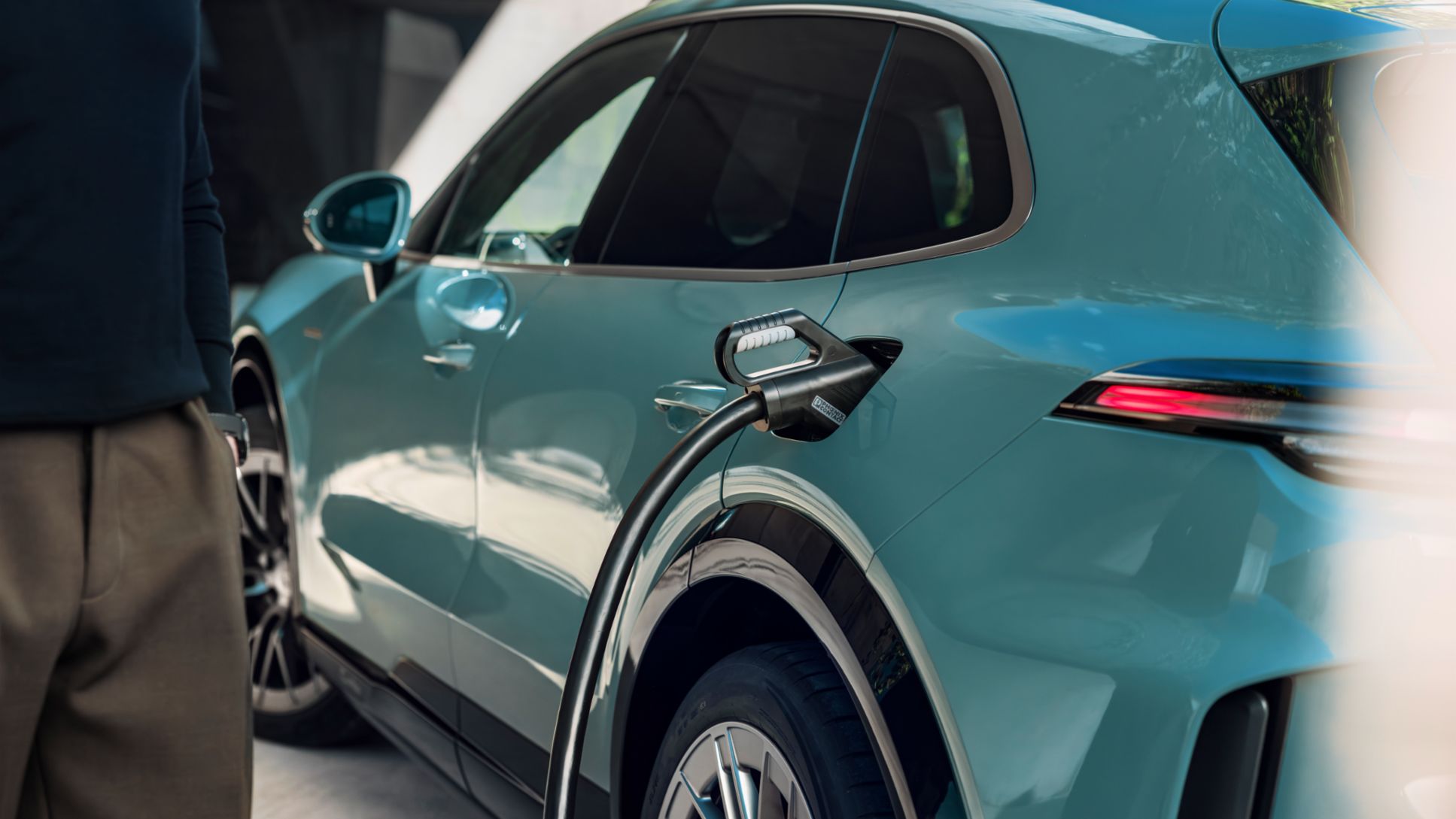
Those who want to cover ground as quickly as possible on long journeys can rely on the Cayenne Electric’s extremely high charging capacity. Thanks to 800-volt technology, the Cayenne can charge at up to 390 kW at a suitable DC charging point and, under specific conditions, a rate of up to 400 kW¹can even be achieved. The SoC (State of Charge) can be increased from 10 to 80 per cent in less than 16 minutes². Or enough energy for a range of 329 (Cayenne S; Coupé: 338 (Cayenne S Coupé Electric (WLTP)*: Electrical consumption combined: 21.2 – 18.9 kWh/100 km; CO₂ emissions combined: 0 g/km; CO₂ class: A)), 325 (Cayenne; Coupé: 335 (Cayenne Coupé Electric (WLTP)*: Electrical consumption combined: 21.4 – 19.1 kWh/100 km; CO₂ emissions combined: 0 g/km; CO₂ class: A)) or 312 (Cayenne Turbo; Coupé: 318 (Cayenne Turbo Coupé Electric (WLTP)*: Electrical consumption combined: 22.1 – 19.9 kWh/100 km; CO₂ emissions combined: 0 g/km; CO₂ class: A)) km can be recharged within 10 minutes³.
One of the main areas of focus during development was robust charging performance.
At 400-volt charging stations, the 800-volt battery is effectively divided into two batteries, each with a nominal voltage of 400 volts, using a high-voltage switch in the battery. This method, known as bank charging, enables particularly efficient charging without an additional HV booster – at an output of up to 200 kW. With typical household wallboxes, AC charging is possible with the standard onboard charger at up to 11 kW, and a 22 kW onboard charger is also available as an option.
The Cayenne Electric keeps its driver informed in real time about every active charging process. Charging time, range, charge level, charging rate and battery temperature are displayed in the Porsche Communication Management (PCM) system and the My Porsche app. If the full charging performance cannot be achieved, for example because the battery temperature is too low, then this is also clearly communicated to the customer. Information about the current charging status is also given via the LED indicator in the standard electric charging flap and the Communication Light in the interior, with a corresponding LED animation.
Even more convenient charging at home: Porsche Wireless Charging
Inductive charging has already radically simplified the way we use mobile phones, with a smartphone only needing to be placed in a charging cradle for charging to begin. Porsche will also offer this user-friendly technology for electric cars in the future⁴, after becoming the first car manufacturer to bring an 11 kW charging system with a one-box floor plate for BEVs to market. ‘One-box’ refers to the fact that, apart from the floor plate mounted in the parking area, no wallbox or control unit needs to be installed. The efficiency of energy transfer from the power grid to the battery is up to 90 per cent.
The fully electric Cayenne will be the first model series from Porsche to be available to order with Porsche Wireless Charging pre-installation and the corresponding vehicle plate. Protected from stone chips and weather conditions, the receiver unit sits between the front wheels in the underbody of the car. To start charging, the Cayenne simply needs to be parked over the floor plate.
The wireless transfer of energy between the two charging units takes place over a distance of a few centimetres. The floor plate features a motion detector and foreign object detection. The charging process is automatically interrupted if a living being comes between the vehicle and the floor plate or if a metallic object is lying on the latter and begins to heat up.
The Porsche Wireless Charging base plate can be mounted in a garage, carport or outdoor parking space and connected to the mains power supply. As always, customers can access support from the Porsche Installation Service. Upon ordering the equipment, a qualified electrician will install the inductive floor plate and put it into operation. A vehicle preparation package and a vehicle charging plate are required to enable contactless charging. Without this preparation, Porsche Wireless Charging cannot be retrofitted
Porsche Wireless Charging is integrated into the My Porsche app, so that the charging processes can be tracked and several vehicles can be authenticated. A special view in the Surround View parking function makes it easier to steer the Cayenne to the optimal charging position. Charging begins as soon as the car is in the correct position above the floor plate and the parking brake is activated. Customers do not need to do anything else. Convenience functions familiar from traditional AC charging, such as timer charging with preconditioning, are also available with wireless charging.
The floor plate, which weighs about 50 kilograms, is equipped with a WLAN module as standard – and, depending on the market, also with an LTE module – so that remote software updates and infrastructure support are guaranteed in the future.
How inductive charging works in detail
Inductive charging is known from smartphones and electric toothbrushes. The energy is transferred through the air via a magnetic field. For this purpose, a copper wire transmitter coil is located in a base plate. Alternating current flows through this coil, which generates a magnetic field.
Porsche's innovative concept uses ultra-wideband technology to determine the vehicle's relative position above a floor plate. The driver is informed when the optimal parking position is reached. The magnetic field generates alternating current in the receiver coil, which is located in the vehicle. A rectifier then converts this into direct current that can be used to charge the Cayenne's high-voltage battery.
The Porsche Wireless Charging base plate is also suitable for outdoor use. All live components are protected from rain and snow. Even driving over the floor plate does not cause it any harm.
----------
¹Cayenne charging capacity under specific conditions with a CCS fast charging station supplying > 400 kW, > 850 V, > 520A, with an initial state of charge of 45 – 48 per cent and a battery temperature of 40°C - 42°C. Maximum charging power with direct current (DC) during charging from 10 per cent SoC to up to 80 per cent SoC under optimal conditions: 390 kW (CCS fast charging station supplying > 390kW, > 850 V, > 520A, with a battery temperature of 15°C, initial state of charge of 9 per cent and remaining range < 60 km).
²Cayenne range added in 10 minutes of charging with direct current (DC) at maximum charging power under optimal conditions (CCS fast charging station supplying > 390 kW, > 850 V, > 520A, with a battery temperature of 15°C, initial state of charge of 9 per cent and remaining range < 60km), based on WLTP consumption of a vehicle with standard equipment according to German market specification.
³Cayenne Charging time with direct current (DC) at maximum charging power from 10 per cent SoC up to 80 per cent SoC under optimal conditions (CCS fast charging station supplying > 390kW, > 850 V, > 520A, with a battery temperature of 15°C, initial state of charge of 9 per cent and remaining range < 60 km).
⁴Porsche Wireless Charging will initially launch in Europe in 2026. Other markets around the world will follow.