As Porsche's most powerful production car to date, the all-electric SUV offers exceptional driving performance on a par with supercars. The all-electric Cayenne line-up initially includes two models: the Cayenne Electric (Cayenne Electric (WLTP)*: Electrical consumption combined: 21.8 – 19.7 kWh/100 km; CO₂ emissions combined: 0 g/km; CO₂ class: A) and the Cayenne Turbo (Cayenne Turbo Electric (WLTP)*: Electrical consumption combined: 22.4 – 20.4 kWh/100 km; CO₂ emissions combined: 0 g/km; CO₂ class: A) Electric. Both of which feature all-wheel drive and are therefore equipped with electronic Porsche Traction Management (ePTM). Porsche uses permanent magnet synchronous electric motors (PSM) on both the front and rear axles.
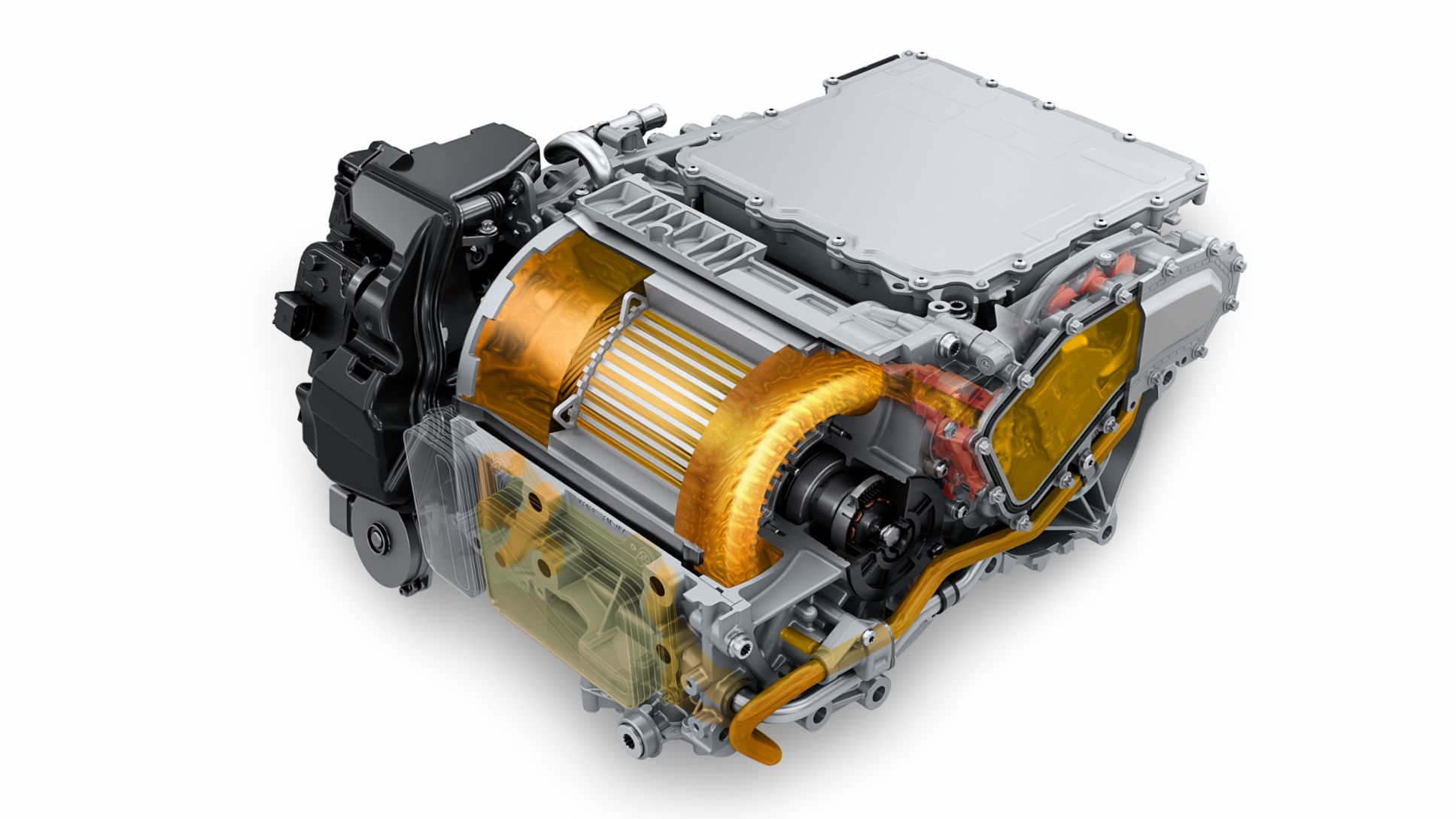
The Cayenne Turbo accelerates from 0 to 100 km/h in 2.5 seconds, reaches 200 km/h in 7.4 seconds and goes on to a top speed of 260 km/h. This outstanding electric performance is made possible by a newly developed drive system that develops up to 850 kW (1,156 PS, (WLTP): Electrical consumption combined: 22.4 – 20.4 kWh/100 km; CO₂ emissions combined: 0 g/km; CO₂ class: A) of power and up to 1,500 Nm of torque when Launch Control is activated. Direct oil cooling, an innovation carried over from motorsport, for the electric motor on the rear axle of the flagship model ensures high continuous output and efficiency. Featuring an electric motor with a diameter of 245 mm and a length of 190 mm, and combined with a 940-amp silicon carbide pulse-inverter, the rear-axle assembly of the Cayenne Turbo features what is currently the most powerful electric drive system from Porsche – developed in-house in Weissach and manufactured in Zuffenhausen. On the front axle is an electric motor with a diameter of 210 mm and a length of 150 mm, coupled with a 480-amp silicon carbide pulse-inverter. In the Normal drive mode, the Turbo delivers up to 630 kW (857 PS), and an additional 130 kW (176 PS) can be called upon for 10 seconds at the touch of a button with the Push-to-Pass function.
The entry-level Cayenne model generates an output of 300 kW (408 PS) in Normal mode. With Launch Control activated, the output increases to 325 kW (442 PS) and 835 Nm of torque. The Cayenne accelerates from 0 to 100 km/h in 4.8 seconds and reaches a top speed of 230 km/h. Its front axle motor, which has a diameter of 210 mm and a length of 100 mm, is combined with a 350-amp pulse inverter. An electric motor with a diameter of 210 mm and a length of 200 mm is installed at the rear, coupled with a 480-amp silicon carbide pulse inverter. This rear motor delivers significantly more power and torque than the drive unit at the front, emphasising the sporty, rear-biased setup of the Cayenne Electric.
In both Cayenne Electric models, the front electric motor is deactivated when power demand is low, and drive comes only from the rear electric motor, increasing efficiency.
Motorsport technology: direct oil cooling for the electric motor
A special feature of the electric drive unit on the rear axle of the Cayenne Turbo is the direct oil cooling. All the current-carrying components are cooled directly. Porsche brought this innovation to the racetrack in Formula E, and now this technology is coming to series production. Direct oil cooling enables very high efficiency, combined with high peak and continuous power output. In conventional electric motors, the coolant flows through a jacket outside the stator, while with direct cooling the coolant flows directly along the copper windings. In this way, the heat can be dissipated directly from where it is generated. To achieve the same efficiency and performance figures, a motor cooled using a water jacket would also have to be approximately 1.5 times larger. Thanks to direct cooling, the Cayenne uses a design that enables up to 98 per cent efficiency in real-world operation.
A synthetic, non-conductive oil is used for immersive cooling of the electric motor: Mobil 1 Therm Electric P, a special dielectric fluid developed by Exxon Mobil. It is non-corrosive and, crucially, has a very low viscosity. Its kinematic viscosity¹ at 100 degrees Celsius is only 1.7 mm2/s which means that it is about five times freer-flowing than engine oil with a viscosity grade of 20 at the same temperature. About six litres of coolant are circulated, but an oil change is not necessary over the system’s entire life cycle. Mobil 1 Therm Electric P and the gear oil for the single-speed transmission system flow in separate circuits but are circulated by a common oil pump, saving both space and weight.
Compact transmission and rear-biased weight distribution
Power is transmitted to the wheels on the front and rear axles via a two-stage single-speed transmission. This enables a compact and lightweight design. For the Cayenne, Porsche has further developed the ‘performance rear end’ that was introduced in the all-electric Macan. The drive unit is now mounted to the rear subframe, further increasing ride comfort. The position of the electric motor on the rear axle has been retained, which is set far to the rear, ensuring a slightly rear-biased weight distribution of 48 per cent front and 52 per cent rear.
Up to 600 kW recuperation power – equivalent to Formula E
The all-electric Cayenne reaches new standards in recuperation; energy can be recovered at a rate of up to 600 kW via the brake pedal, depending on the speed, temperature and the state of charge of the battery.
The level of recuperation in the Cayenne Electric therefore matches that of the Porsche 99X Electric, with which the sports car manufacturer competes in the Formula E racing series. Recuperation is also active during more dynamic driving, meaning that around 97 per cent of braking operations in everyday use are taken care of by the electric motors alone, without using the friction brakes. Depending on the particular braking manoeuvre, the recuperation can even be used to bring the car to a complete stop. As soon as the deceleration exceeds the recuperation limit, the friction brakes are applied – virtually imperceptibly to the driver.
The driver can also activate ‘overrun’ recuperation. The centre display can be used to select the three levels ‘On’, ‘Off’ or ‘Auto’:
- In ‘On’ mode, releasing the accelerator pedal initiates recuperation at a moderate rate of 0.5 m/s². This is roughly equivalent to the deceleration experienced from engine braking in a combustion-engined car. In the Sport Plus drive programme, this rate is increased to 0.8 m/s2 for the benefit of driving dynamics. This setting suits keen drivers who appreciate maximum feedback.
- In ‘Off’ mode, the vehicle coasts without applied deceleration – ideal for an economical driving style.
- The ‘Auto’ mode allows the vehicle to coast freely in flowing traffic. As soon as a vehicle is detected in front, the ‘overrun’ recuperation automatically decelerates at a rate of up to 1.5 m/s².
ePTM enables impressive off-road capability
The Cayenne opens up a new dimension, not just in terms of longitudinal and lateral acceleration. Its off-road capabilities are also remarkable, giving even less experienced drivers a constant feeling of confidence and safety. Due to the nature of electric motors, the drive system offers high torque right from a standstill. When stopping or setting off on a hill, this torque can also be very precisely regulated. Roling backwards unintentionally is prevented by halting the electric motor in place, a function that has been specially integrated by Porsche.
The electronically controlled Porsche Traction Management (ePTM) reacts about five times faster than a conventional all-wheel drive system. Within five milliseconds, it responds to a variety of input variables such as acceleration, drive torque, vehicle speed and traction slip, and it can adjust the torque distribution to suit the particular driving situation as required.
-------
¹Generally speaking, viscosity describes the flow behaviour of a liquid. Kinematic viscosity is a term used to express internal friction of a fluid. It indicates how fast a liquid can be subjected to gravity flows along a defined route.