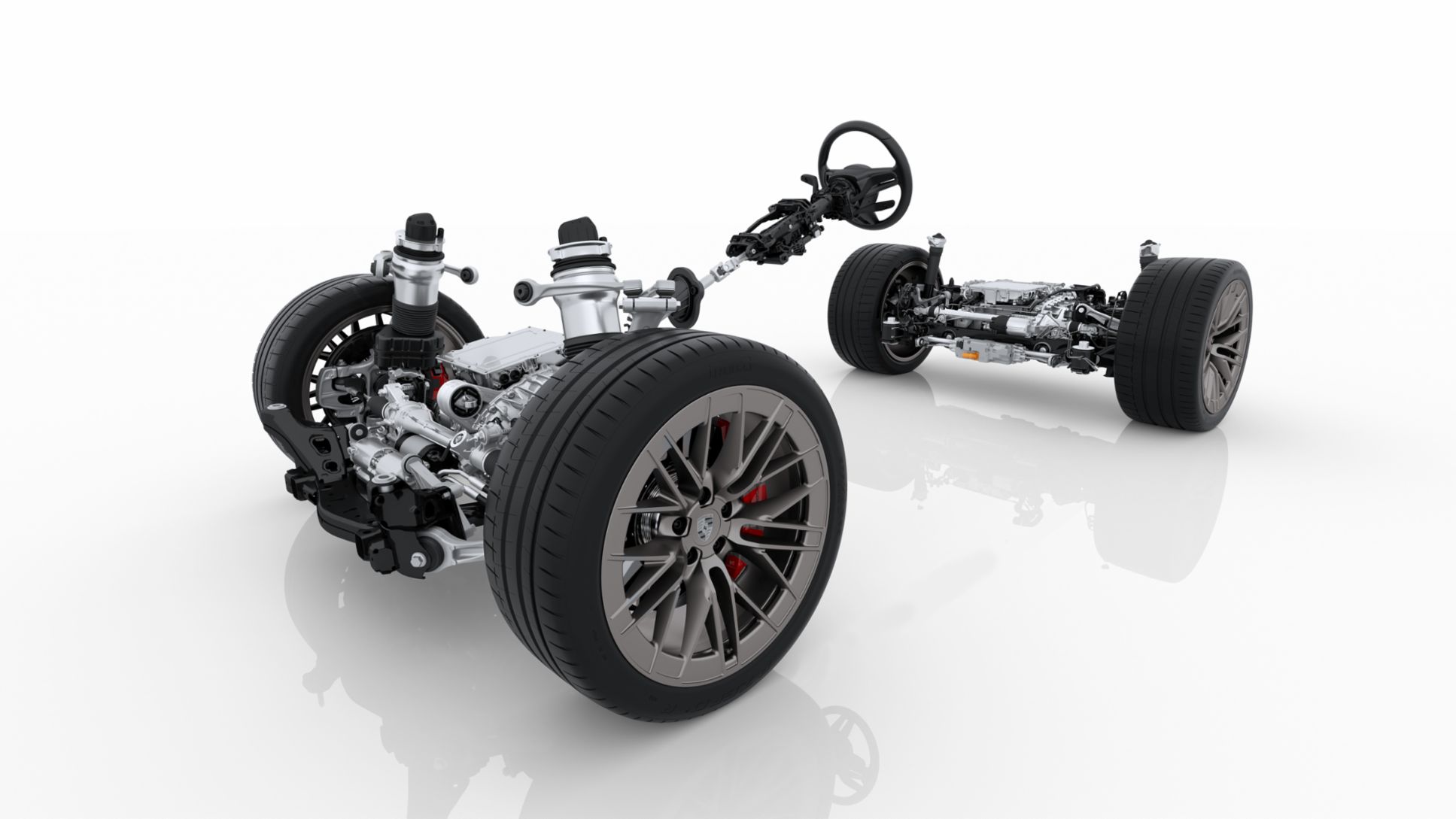
The Cayenne Electric is an all-rounder par excellence and offers a wide range of everyday usability and quintessential Porsche performance, as well as excellent off-road and towing capabilities. The suspension plays a major role in this. At the front, the SUV is fitted with double-wishbone suspension with separate control arm levels. Its elastokinematic properties ensure excellent responsiveness, steering precision and straight-line stability. The multi-link rear suspension is mounted to the rear subframe, which is connected to the body with flexible mounts. In addition, the rear electric drive unit is attached directly to the subframe via three points (or four points for the top-of-the-range model). Separating the drive unit from the chassis, and instead mounting it to the rear subframe, directly benefits ride comfort while also minimising weight.
The Turbo (Cayenne Turbo Electric (WLTP)*: Electrical consumption combined: 22.4 – 20.4 kWh/100 km; CO₂ emissions combined: 0 g/km; CO₂ class: A) model is also equipped as standard with Porsche Torque Vectoring Plus – an electronically controlled differential lock on the rear axle, with fully variable power distribution. The control strategy is tailored to the particular driving situation and ensures enhanced traction, driving stability and lateral dynamics. Steering response and steering precision are aided by targeted dynamic brake actuations on the rear axle.
The list of standard equipment also includes self-levelling adaptive air suspension and Porsche Active Suspension Management (PASM) electronic damper control. The system uses a wide range of information – including the vehicle speed; the rate of heave, pitch and roll of the body; longitudinal and lateral acceleration; drive torque; steering input and ride height setting – to continuously adjust the damping for each wheel and the body individually. Thanks to two-valve technology, the rebound and compression stages can be separately adjusted. The air suspension allows different levels of ride height to be selected to suit the ground surface. The three submenus of the off-road driving programmes – Gravel/Mud, Sand and Rock – allow the driver to adjust the driving dynamics according to the terrain. This is achieved with, among other things, different accelerator pedal maps. Another strength off-road: the electronically controlled differential lock, which is fitted as standard in the top-of-the-range model, increases traction even further and, in the various off-road driving modes, distributes torque in a manner to suit the particular ground surface in order to achieve maximum traction when pulling away.
Enhanced driving dynamics and increased ride comfort thanks to Porsche Active Ride
For the first time in an SUV, Porsche is offering Porsche Active Ride for the Cayenne Turbo Electric. This active suspension significantly broadens the spectrum between performance and ride comfort. Porsche Active Ride keeps the body parallel to the ground, even during periods of heavy braking, steering and acceleration, which noticeably increases ride comfort in the Normal drive mode. In off-road use, Porsche Active Ride enables a high degree of articulation of the axles thanks to the absence of mechanical anti-roll bars.
For the first time, the Cayenne features a Comfort drive mode. Intelligent ride-height control and comfort-biased damper control ensure maximum isolation of the body and passenger compartment from undesirable forces and vibrations, resulting in maximum comfort. In this drive mode, the additional ‘cornering comfort’ and ‘pitch comfort’ functions are active by default. This reduces the longitudinal and lateral forces acting on passengers during acceleration, braking and cornering through targeted compensation of roll and pitch from the Porsche Active Ride system.
Porsche Active Ride enhances driving dynamics during high-performance driving. For maximum traction, the body is kept level and dynamic distribution of wheel loads is intelligently controlled during cornering. Porsche Active Ride uses sensors to calculate and monitor the dynamic wheel load on each wheel and, as a result, the maximum grip level for each wheel. The system acts in real time by adjusting the distribution of power to each wheel, without slowing the forward drive. By adjusting the damper force, the load on a wheel can be either increased or decreased.
The Cayenne Electric’s driving dynamics also benefit from the low centre of gravity that is typical of battery-electric vehicles. Compared to the combustion-engined model, the centre of gravity is 83 mm lower.
The new Cayenne is one of the world's first BEVs to offer a towing capacity of up to 3.5 tonnes, depending on the market and specified equipment. The fact that it can tow heavy trailers with ease while delivering the same impressive driving experience that it does when uncoupled is due, among other things, to the special use of Porsche Active Ride. The approximate mass of the trailer is determined electronically and then taken into account by the active suspension system. The throttle response is also adapted accordingly.
How Porsche Active Ride works in detail: all four active dampers are connected to a motor pump unit on each axle. In addition to their damping function, these also take on the role of performing as anti-roll bars. This means that, unlike with the standard air suspension, anti-roll bars could be omitted. During off-road driving, this offers the advantage of greater axle articulation. At the same time, the system also significantly increases ride comfort in the event that one side of the road is particularly uneven. The motor/pump unit generates the active actuating forces at the dampers on demand within milliseconds. The system is powered directly from the high-voltage battery.
Rear-wheel steering for a tighter turning circle and even greater high-speed stability
The Cayenne is optionally available with rear-wheel steering. It reduces the turning circle from 12.7 m to 11.6 m, thereby contributing to increased agility in urban traffic and while driving off-road. The required steering angle is reduced by 24 per cent, which means that the driver does not need to turn the wheel as far. The rear-wheel steering system also provides enhanced stability and driving precision on country roads and motorways. Another advantage is the precise, totally direct steering feel that is typical of the Porsche brand.
Depending on the vehicle speed and the driving conditions, the electromechanical actuator generates a steering angle at the rear wheels. At speeds below 100 km/h, the rear wheels turn in the opposite direction to the front wheels, providing an even more direct turn-in response. In addition, lateral acceleration is built up more quickly during cornering. The steering angle at the rear wheels is up to five degrees at low speed, which makes manoeuvring much easier. The virtual shortening of the wheelbase by means of rear-wheel steering also results in more responsive steering behaviour when cornering. Above 100 km/h, the rear wheels turn in the same direction as the front wheels, which further increases stability, for example when changing lanes on a motorway. The rear-wheel steering is accompanied by a 12.5-per-cent-more-direct steering ratio on the front axle in the all-electric Cayenne, further increasing agility.
The front-axle steering is designed in typical Porsche fashion, offering maximum precision, highly responsive dynamics and therefore optimal control during all steering manoeuvres. Porsche has also developed an intelligent power-assisted steering system that provides distinct, natural feedback, allowing the driver to feel the condition and current grip level of the road. This gives a true steering feel, which is especially important during periods of particularly spirited driving. Unwelcome vibrations and bumps, however, are eliminated and are not transmitted through to the steering wheel.
High-performance braking system: Porsche Ceramic Composite Brake (PCCB)
The Porsche Ceramic Composite Brake (PCCB) system is available as an option for the top-of-the-range model. Its ceramic brake discs are extremely resistant to heat and are significantly lighter than cast iron discs of the same performance level. This reduces the unsprung mass, further enhancing driving dynamics, comfort and braking performance. The front discs have a diameter of 440 mm, and 410 mm discs are fitted at the rear.