For 75 years, Porsche has been writing motorsport history. The first chapter is considered to be the 24 Hours of Le Mans in 1951, where a factory-prepared Porsche 356 SL achieved a class victory in the hands of a customer team. Porsche’s triumphant march in Daytona begins just a few years later, on 5 April 1959. Less than two months after the official opening of the impressive Daytona International Speedway, the United States Auto Club (USAC) stages a sports car race for the first time. Even back then, the layout consists of a combination of the NASCAR oval and the infield road course. The championship race, originally scheduled to run over 1,000 kilometres, is stopped after six hours due to nightfall. The winners come from Argentina – and they are driving a Porsche: Roberto Mieres and Antonio von Döry take victory in a 718 RSK ahead of the Porsche driven by Americans Bob Said and Art Bunker. Because a different sanctioning body was involved, this race does not appear in the official IMSA statistics.
All overall and class winners: IMSA Daytona statistics
The 1960s: double podium celebrations for the Porsche winners
IMSA’s official Daytona history begins in 1962 – although the championship round at that time is not yet a 24-hour race. In that year and the following season, the sports car event runs over three hours, before being extended to a distance of 2,000 kilometres in the next two years. For the first time, the cars race twice around the clock in Daytona in the 1966 season. Porsche has to wait only until 4 February 1968 for its first overall victory: Entered by the Porsche System Engineering works team, a 907 LH crosses the finish line with a commanding lead, followed by two identical sister cars. A curious detail: On the instructions of then Porsche race director Huschke von Hanstein, works drivers Jo Siffert, Rolf Stommelen and Hans Herrmann also take turns driving the leading No. 54 car of Vic Elford and Jochen Neerpasch for five laps each in the closing stages – meaning that the trio are also officially classified as winners of the race. Siffert and Herrmann also step onto the podium a second time as runners-up.
Mourning Hans Herrmann: On the death of Porsche's first Le Mans overall winner
The wild 1970s: Porsche 917 victories and Brumos sets early benchmarks
At the start of the 1970s, the Porsche 917 KH entered by John Wyer Engineering are the benchmark. The lightning-fast race cars from Weissach win the 24 Hours of Daytona in 1970 and 1971 in the legendary Gulf livery, engaging in thrilling battles with Ferrari. After a six-hour race in 1972, Porsche celebrates another triumph the following year: In 1973, the Porsche 911 Carrera RSR of Daytona record winner Hurley Haywood and his perfectly matched partner and Brumos boss Peter Gregg defeats the strong opposition. It is the first victory for the legendary Brumos Porsche team, which shapes the history of Daytona like no other. Further 911 Carrera RSR victories follow in 1975 and 1977. An unparalleled winning streak then begins, lasting until 1987: initially with derivatives of the 935, followed by the 962 – interrupted only by a March victory in 1984, albeit powered by a Porsche engine.
“The Porsche engineers always had an innovative answer to every challenge back then,” recalls Hurley Haywood, five-time overall winner of the 24 Hours of Daytona. He cites the 962 as an example: “The car was the response to the fact that IMSA did not allow the Porsche 956 in North America because the driver’s feet were located ahead of the front axle. Porsche simply moved the seating position further back and extended the wheelbase – and with the 962, one of the most successful race cars of all time was born.”
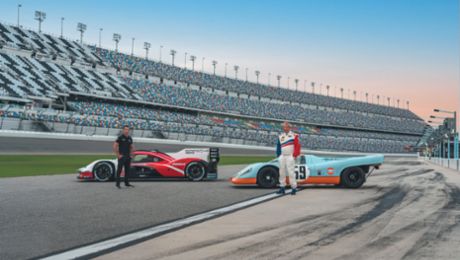
Porsche 917 meets Porsche 963: photo shoot in Daytona
Visiting the Brumos Collection: true Daytona legends
Around the turn of the millennium: The 911 scores a sensational overall victory
From 1985 to 1991, the winners drove the Porsche 962 with the additional designation “IMSA”. These successes, along with the triumph of the Kremer K8 with Porsche power at the rear, continue Porsche’s magnificent Daytona story into the late 1980s and 1990s. A highlight that remains almost unbelievable to this day follows in 2003: Competing against the nominally superior Daytona Prototypes of the top class, the Porsche 911 GT3 RS takes overall victory.
Americans Kevin Buckler and Michael Schrom share the 911 fielded by The Racer’s Group with today’s Porsche brand ambassadors Timo Bernhard and Jörg Bergmeister. “We had already built up a few laps’ lead early in the race – but by no means enough that we could relax and simply nurse the car home. Quite the opposite: we found ourselves in a situation we had never imagined. A GT car on course for overall victory? Essentially unthinkable,” recalls Bergmeister. “During the night, we had a conversation in the pits along the lines of: ‘Unbelievable, but this could actually happen!’ That was when our initial disbelief turned into a concrete – and ultimately successful – plan,” adds Bernhard.
From 1959 to today: successful Porsche race cars in Daytona
Porsche 963 as benchmark: a third consecutive Daytona victory in 2026?
During the long era of Daytona Prototypes, Porsche adds its name to the winners’ list twice more in the 2000s as an engine partner. After an interlude with DPi cars, a unified technical regulation is finally introduced together with the FIA World Endurance Championship (WEC). Porsche develops the hybrid prototype 963 together with its partners and fields it from 2023 onward under the Porsche Penske Motorsport banner, both in the world championship and in the IMSA series. This approach proves hugely successful, particularly in North America: Daytona victories in 2024 and 2025, along with all GTP championship titles in both seasons.
“We want more,” states Thomas Laudenbach, Vice President Porsche Motorsport, with a clear view towards the new season. “In the anniversary year of Porsche Motorsport and on the 60th birthday of Team Penske, we have clear objectives: third consecutive Daytona victory with the Porsche 963, and we intend to compete for titles in the IMSA series again in 2026.”
Review of the 2025 IMSA season: a magnificent year
Information from the organiser on the pre-test: Roar Before the 24