At a glance
- The centrally positioned tachometer originates from motorsport and has influenced Porsche since the 550 Spyder.
- The circular instruments have been carried over from racing to production models for generations.
- Even in the digital cockpit, the central focus remains a defining element of Porsche’s motorsport DNA.
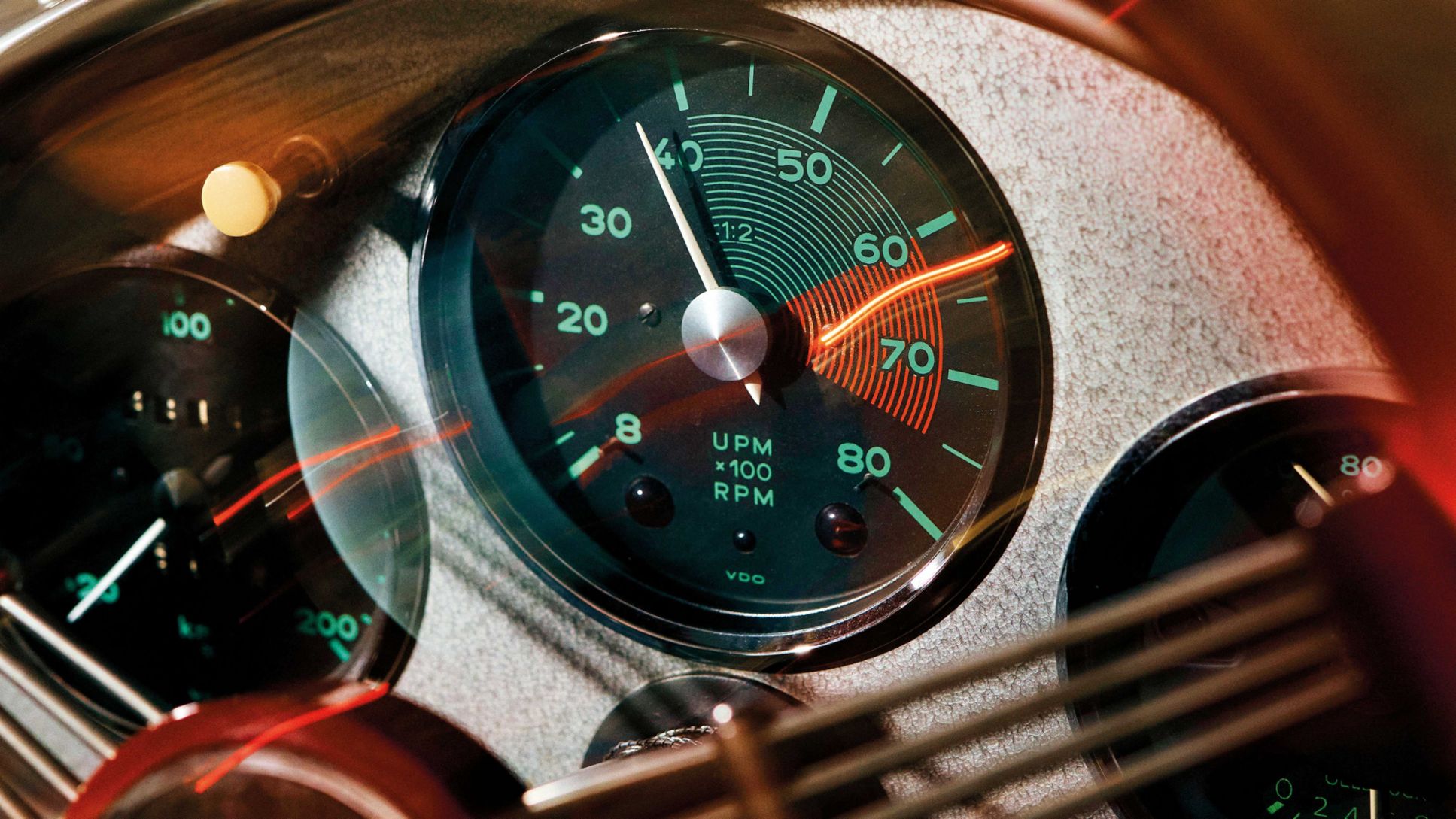
For more than seven decades, familiar details in the Porsche cockpit, such as round instruments and, in particular, the centered tachometer, have formed a bridge through time. The tachometer remains a constant in the line of sight of many Porsche drivers and, like so many of the sports car manufacturer’s other developments, also originates in racing – in the 550 Spyder from 1953, the first Porsche designed specifically for motorsport.
A look back at November 1953: Hans Herrmann and Karl Kling compete at the Carrera Panamericana public road race in Mexico with two 550 Spyder. The exact speed is secondary for race car drivers – they always drive as fast as possible anyway. What’s most important are the rpms, which are key to the engine’s health and indicate the perfect shift point.
And so Porsche relocates the tachometer in the 550 Spyder to the center of the round instruments, allowing drivers to intuitively and thus continuously monitor the rpms. The 550 features a chrome-framed display with the numbers 0 to 80 in light green on a black background. The abbreviations UPM and RPM × 100 transform the figures into a veritable firework of true revolutions per minute. Between 4,000 and 6,000 revolutions, the white needle shoots to the green section of the instrument. Any higher than that, and the needle leaves the boxer engine’s sweet spot and enters the red zone, which serves as a warning to show some restraint.
The new cockpit layout with the tachometer in the center proves its worth: Although it doesn’t lead to victory this year, just one year later Hans Herrmann is class winner at the Panamericana in the 550 Spyder and comes third overall. Thanks in part to the tachometer, he is able to combine maximum performance with minimal wear on components.
From racing to the road
In 1955, the centered instrument conquers the new 356 A. By the time the 911 (still known as the 901 at that time) makes its debut in 1963, the centered tachometer is already a part of the Porsche DNA. While the 550, the 356, and the early 912 get by with just three round instruments, that number increases to five in the 911. Eventually, the 914, the Boxster, and the Cayman – all mid-engine models – reintroduce the triad as a homage to the 550, which is also fitted with a mid-engine. Only the transaxle models – the 924, the 944, the 968, and the 928 – and the first Cayenne go their own route, their cockpits putting equal emphasis on the speedometer and tachometer.
In the age of digitalization, the tachometer manages to learn a few new tricks and, still in the center, also displays speed. And from that point onward, this interplay of information is a standard feature intuitively used by Porsche drivers. Despite all of that, the architecture of the round instruments does not lose any of its clarity. In the current 911, it merges seamlessly with the cockpit of a new era – the perfect balance of form and function expressed as a display.
Info
Text first published in Christophorus Magazine, issue 417.
Text: Thomas Fuths
Images: Constantin Mirbach
Copyright: All images, videos and audio files published in this article are subject to copyright. Reproduction in whole or in part is not permitted without the written consent of Dr. Ing. h.c. F. Porsche AG. Please contact newsroom@porsche.com for further information.