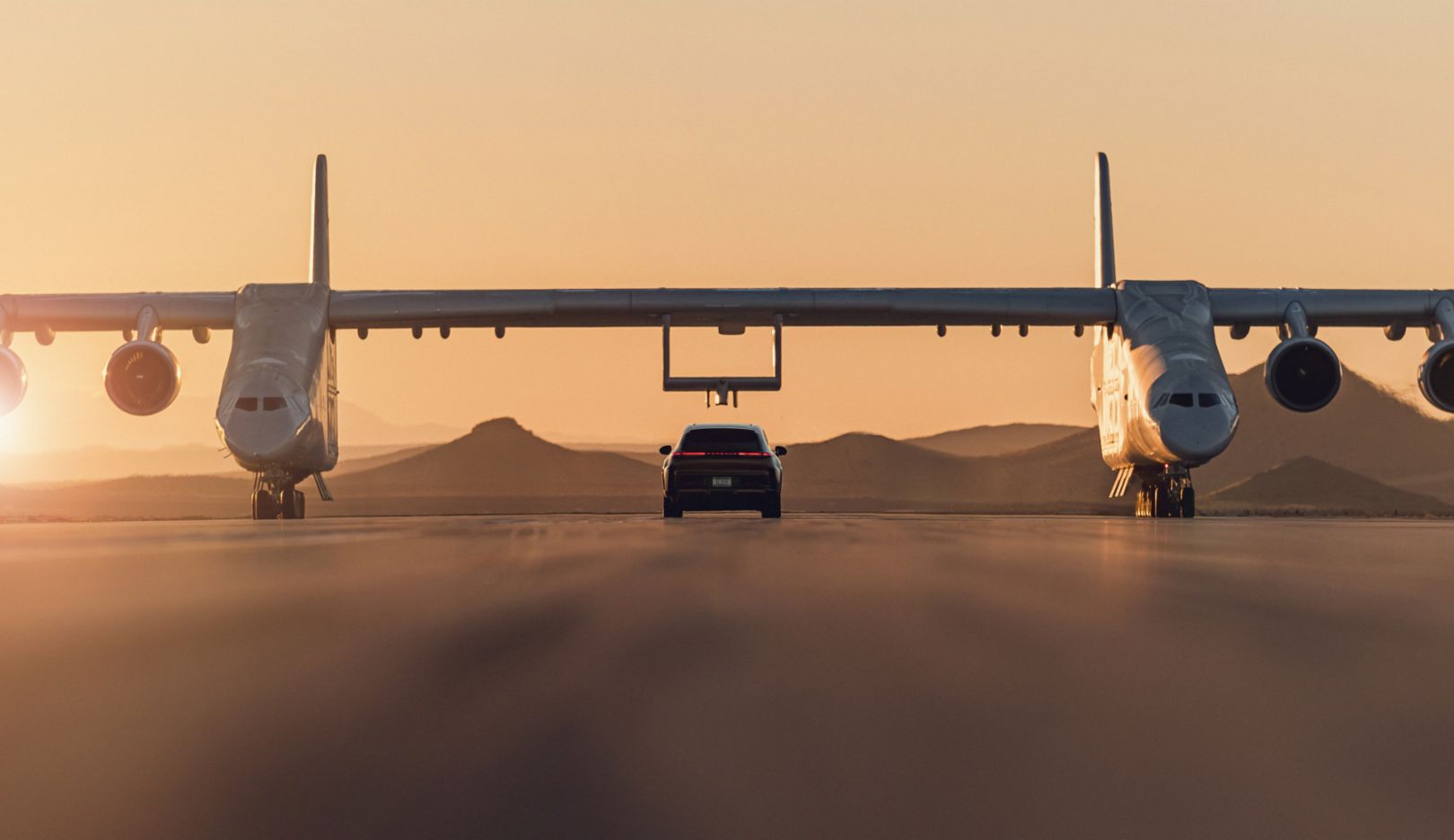
An experimental aircraft and a cutting-edge Porsche accomplished a feat that was born, as many of the best ideas are, out of sheer curiosity:
At a glance
- Not a race, but instead a test of precision, stability and power as the Cayenne had to remain precisely in the right position, all while traveling at speed.
- Engineers at Stratolaunch, operators of “Roc,” the world’s biggest aircraft, calculated the feat was possible; the new Cayenne Turbo Electric and Patrick Long became the first to prove it.
- With a wingspan of 385 feet and 340,500 pounds of thrust, Roc can take off with a maximum weight of 1.3 million pounds.
Based at Mojave Air and Space Port and responsible for Roc – the world’s largest plane by wingspan – Stratolaunch engineers tasked with understanding the complex aerodynamics of the aircraft calculated that, thanks to its unique design, a car with sufficient power and stability could travel beneath it as it took off and also as it landed. And so began an extraordinary project that would bring together two like-minded teams, and ultimately two similar machines.
WATCH: Can the Porsche Cayenne Turbo Electric keep pace with the world's largest aircraft?
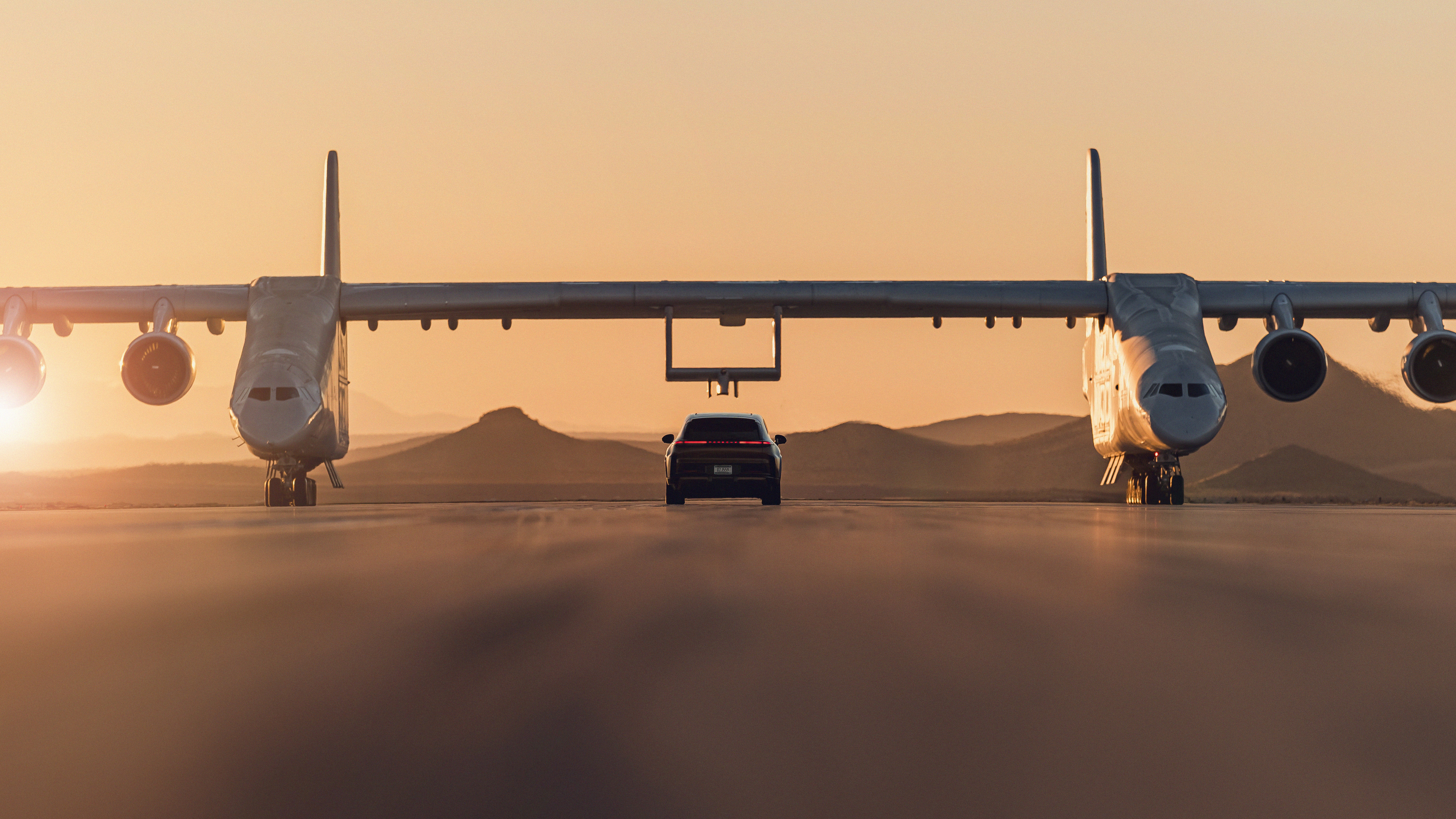
While Porsche engineers shared the same enthusiasm to prove this aerodynamic oddity existed – and that a car could pass beneath an aircraft as it took off – the list of demands were daunting. Required was a mix of enormous power to stay with the aircraft at all speeds, stability, precision, and the capacity to accelerate beyond 160mph to exceed the takeoff speed of Roc. The new Cayenne Turbo Electric emerged as the ideal candidate. At its core, the Cayenne has always been capability in all conditions, but also surefooted performance when it’s most needed. These traits are abundant in the Cayenne Turbo Electric (which joins the combustion engine and E- Hybrid variants on sale today) as it generates a total of 1,139 hp, accelerates from 0 to 60 mph in 2.4 seconds and is equipped with active aerodynamics making it not only extremely quick but also surefooted at speed. A prototype vehicle was transported to Mojave, with endurance racer and former Porsche factory team driver Patrick Long letting curiosity get the better of him as he volunteered to take on the feat.
Cayenne versus World's Largest Aircraft
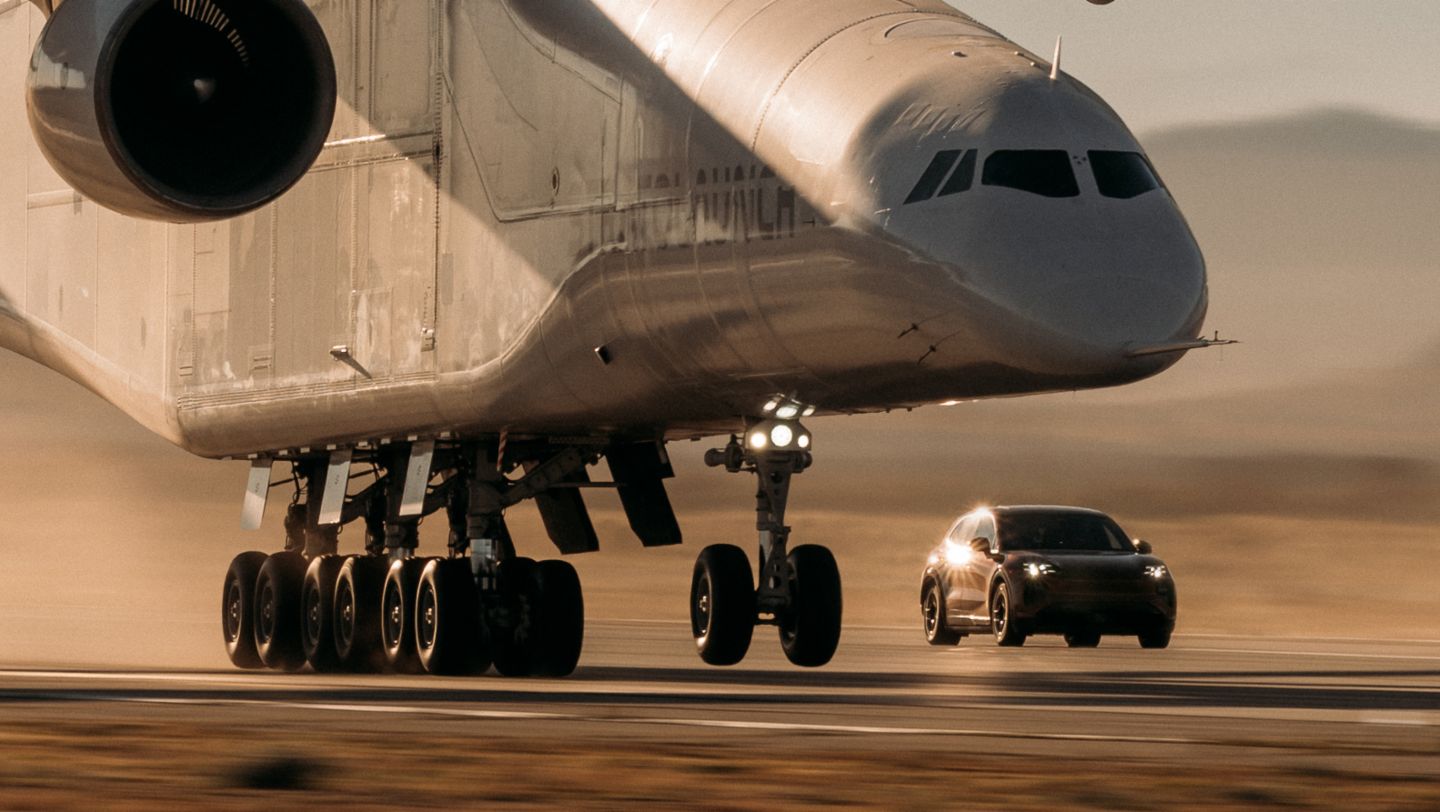
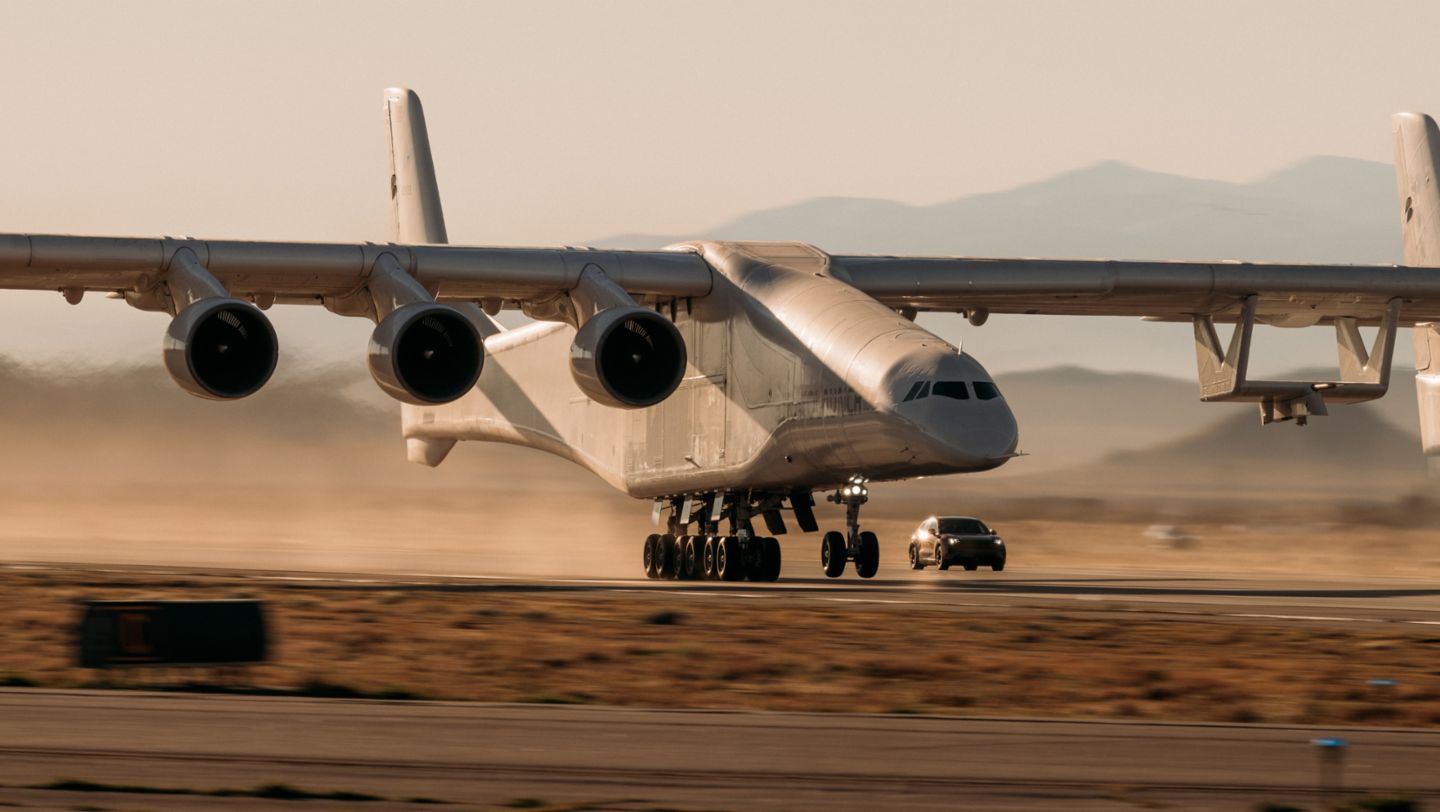
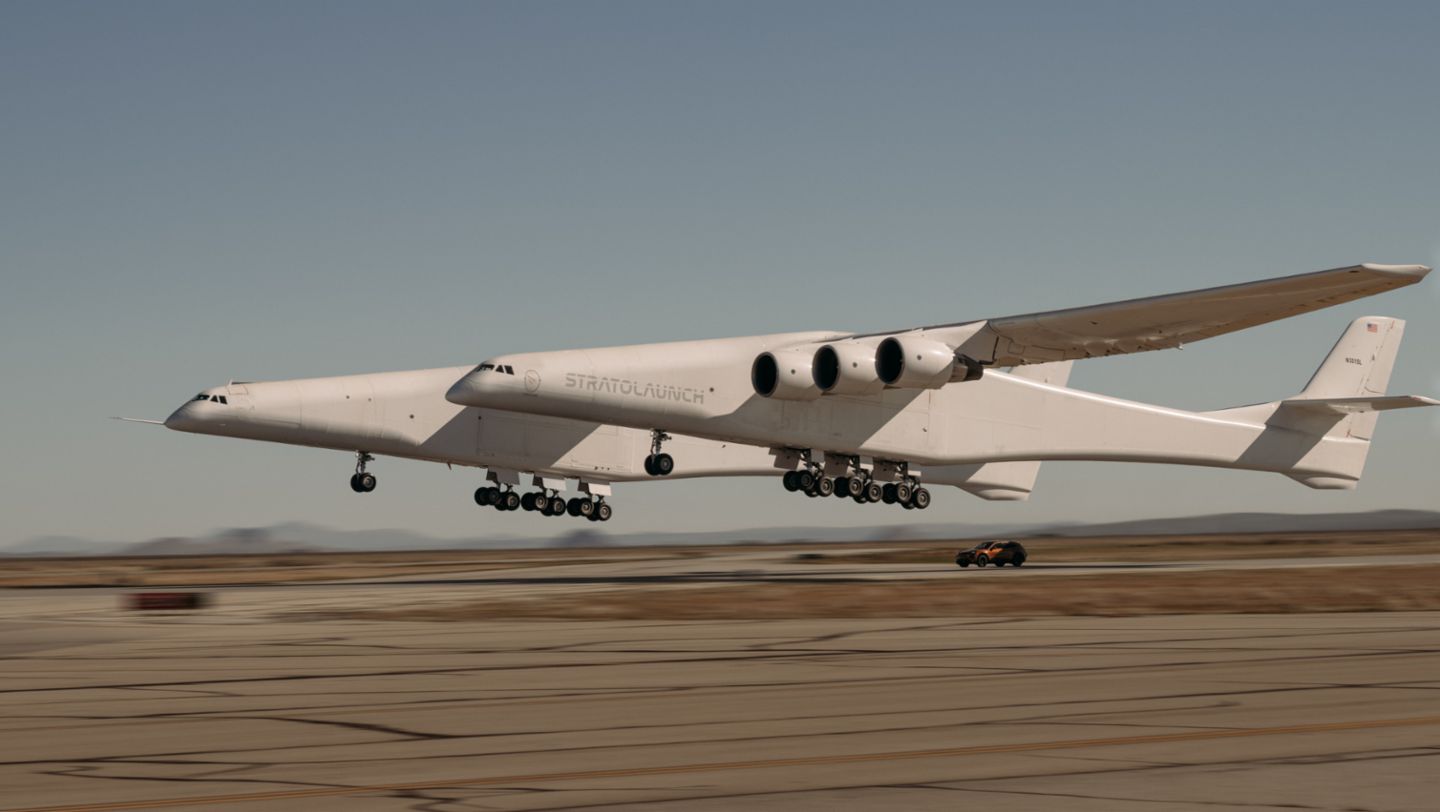
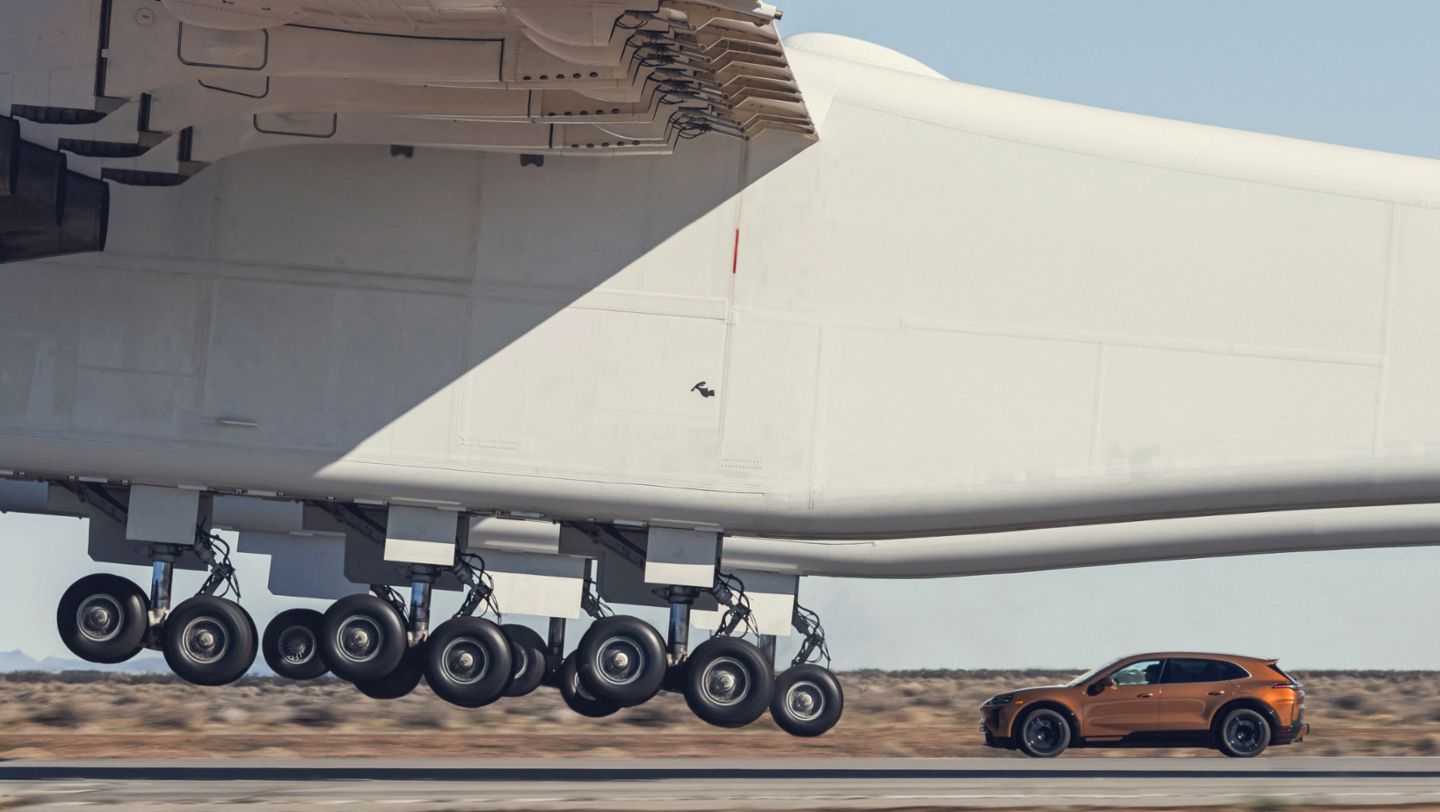
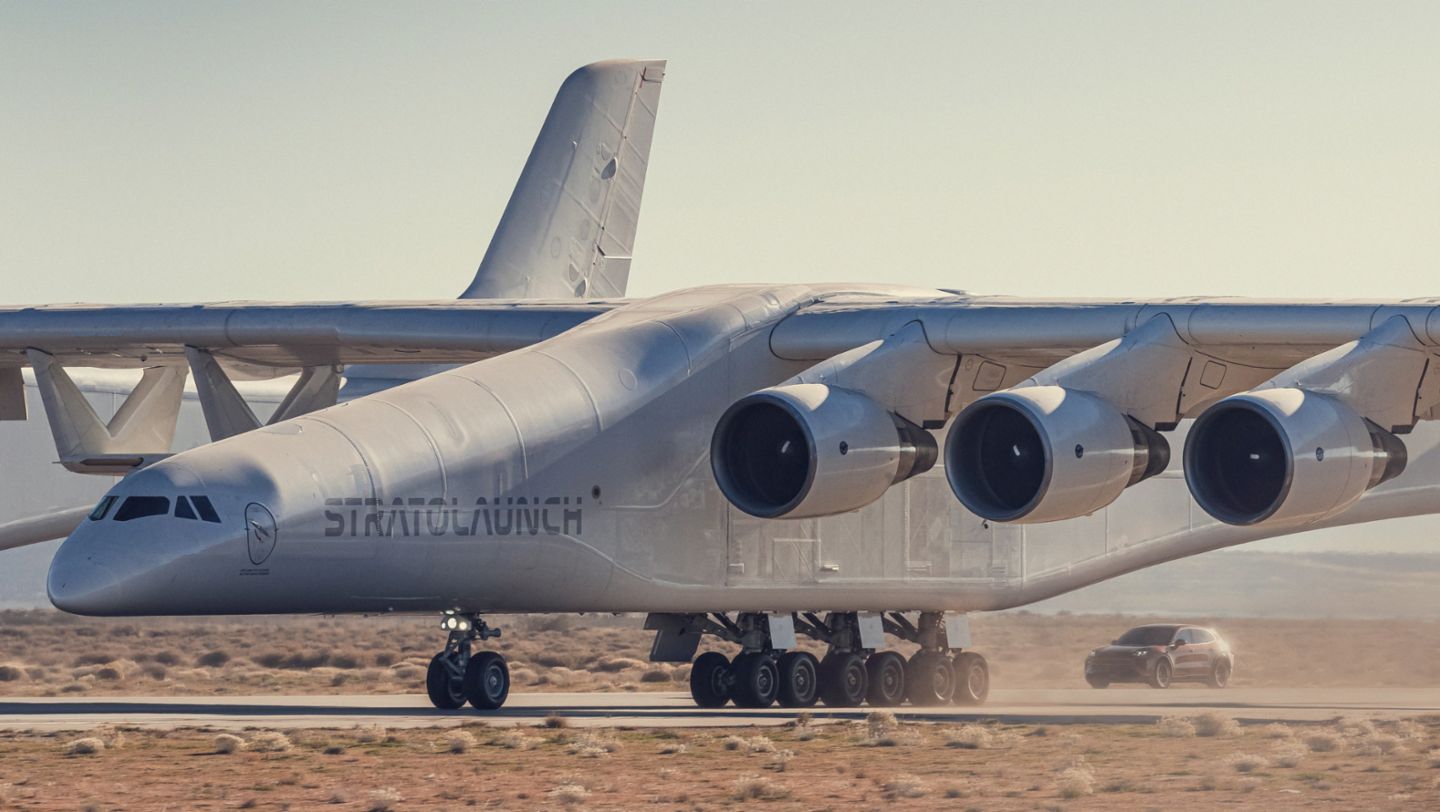
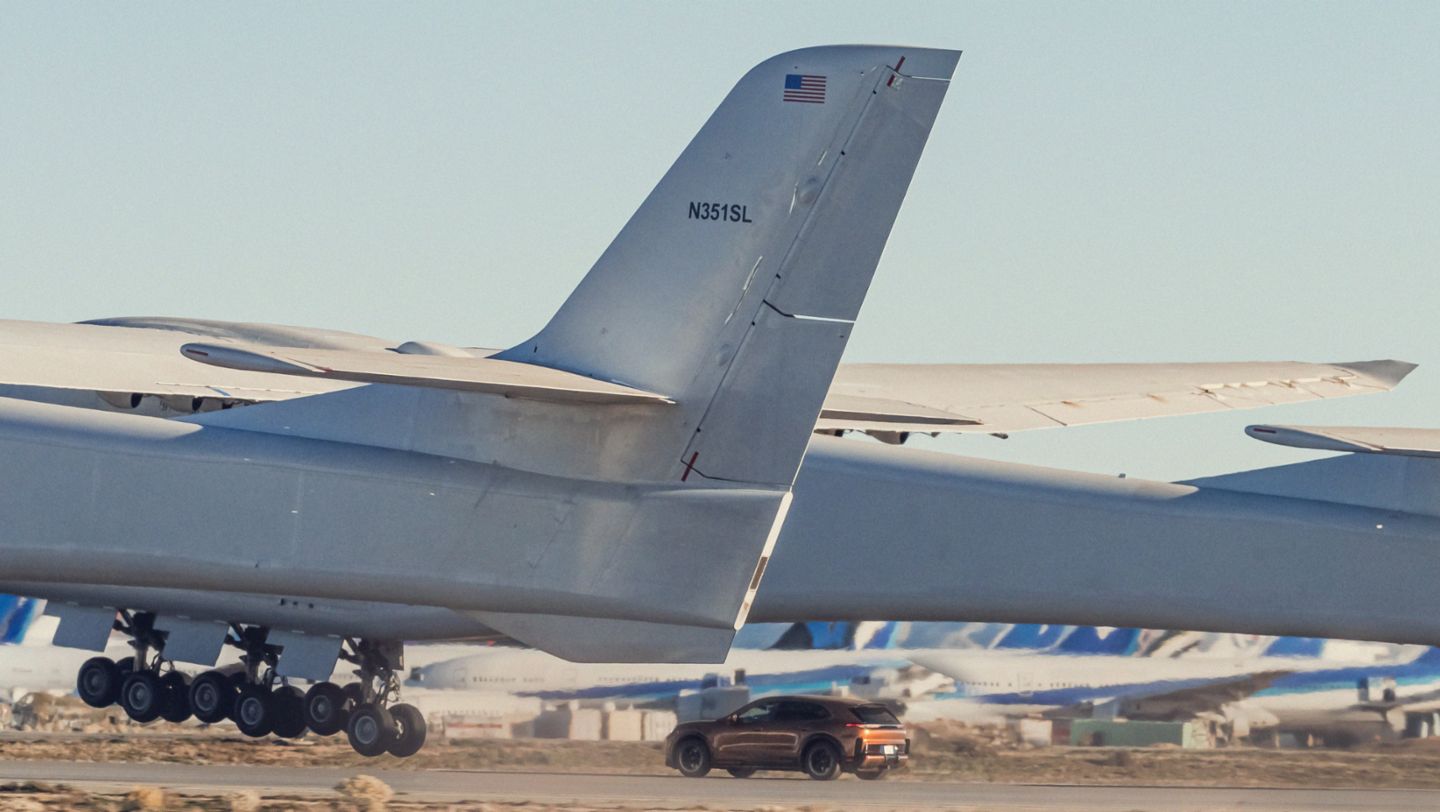
Constructed out of composites and designed to be a launch platform for spacecraft and cutting-edge hypersonic testing, Roc has a wingspan of 385 feet and develops 340,500 pounds of thrust – making it more powerful and significantly larger than even the Airbus A380. Beneath the aircraft during take-off and landing is an intense storm of jet blast and turbulence – with one small exception. A space was calculated to exist just behind the trailing edge of the landing gear, but ahead of the tail, where the storm calms. This bubble moves with the aircraft during takeoff and landing – meaning anyone who attempted to drive a vehicle in such a space would be committed to staying within a very precise spot from the moment the engines started through to take off.
This was not a drag race down a runway, but a test of precision, nerves and complete reliance on two groundbreaking machines.
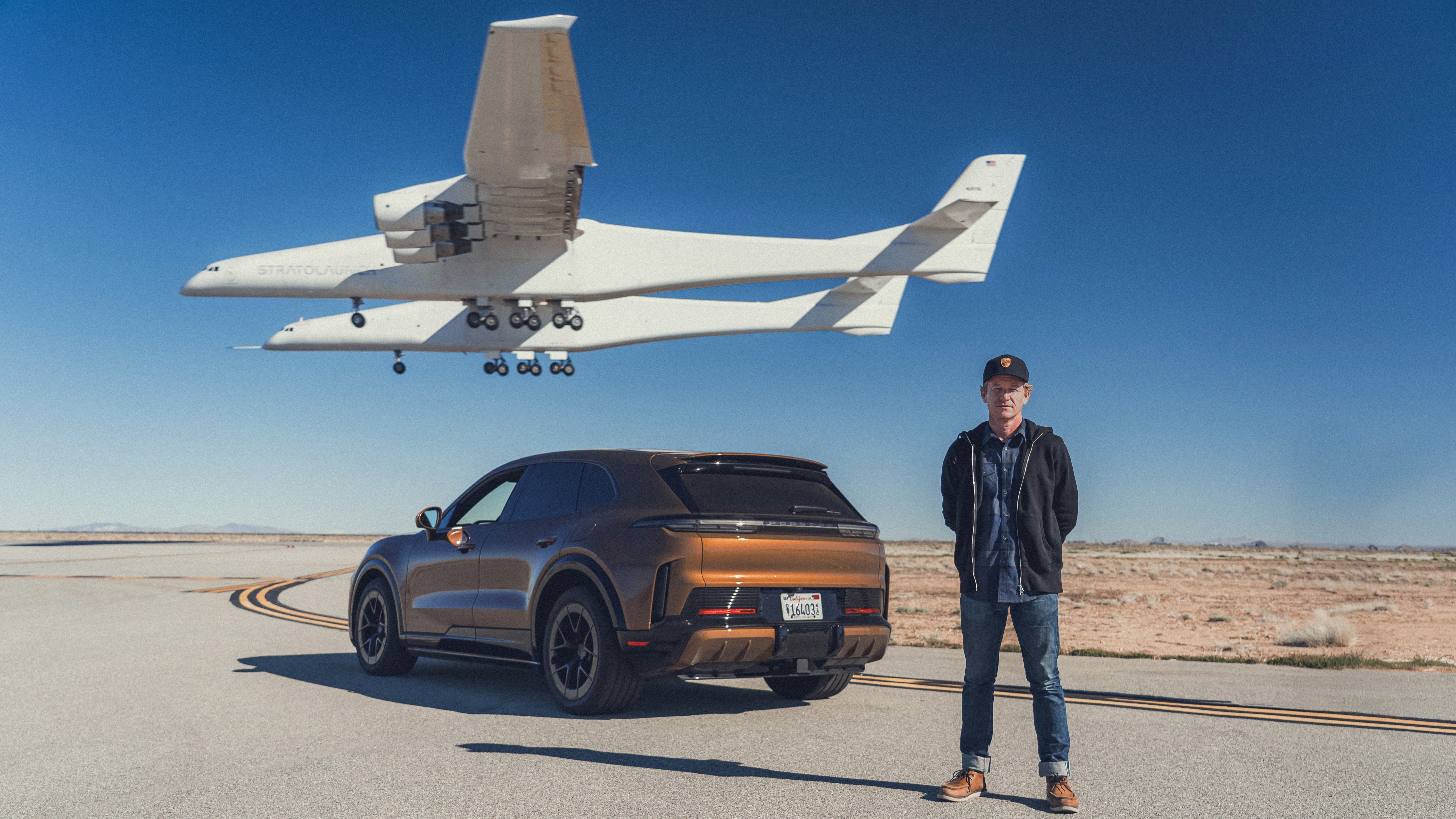
“It was probably one of the most focused and intense moments of my life,” said Patrick Long, reflecting on the minutes before the first flight. “We believed in the data, and I knew I could rely on the Cayenne and the pilots of Roc – we had a good team. Operating with a fully charged battery, we started slow – I was using minimal power and holding the car exactly where it needed to be and I knew I had the performance to maintain my position no matter what. The real acceleration occurred once all six engines spooled up. As the speeds shot north of 100 mph, I put it in Boost mode and utilized everything the Cayenne had – keeping right on the landing gear. It was an awesome feeling – the sound from those six engines was overwhelming and I could feel the turbulence bouncing off the car, but it remained rock solid, even after Roc took off and the engines were pointed down at me and the Cayenne. At that moment I glanced at the speed which showed somewhere north of 170mph before I eased off the throttle,” he explained. Speeding towards the end of the runway, the massive optional Porsche Carbon Ceramic Brakes helped to slow down the Cayenne Turbo Electric from these extreme speeds with consistent authority.
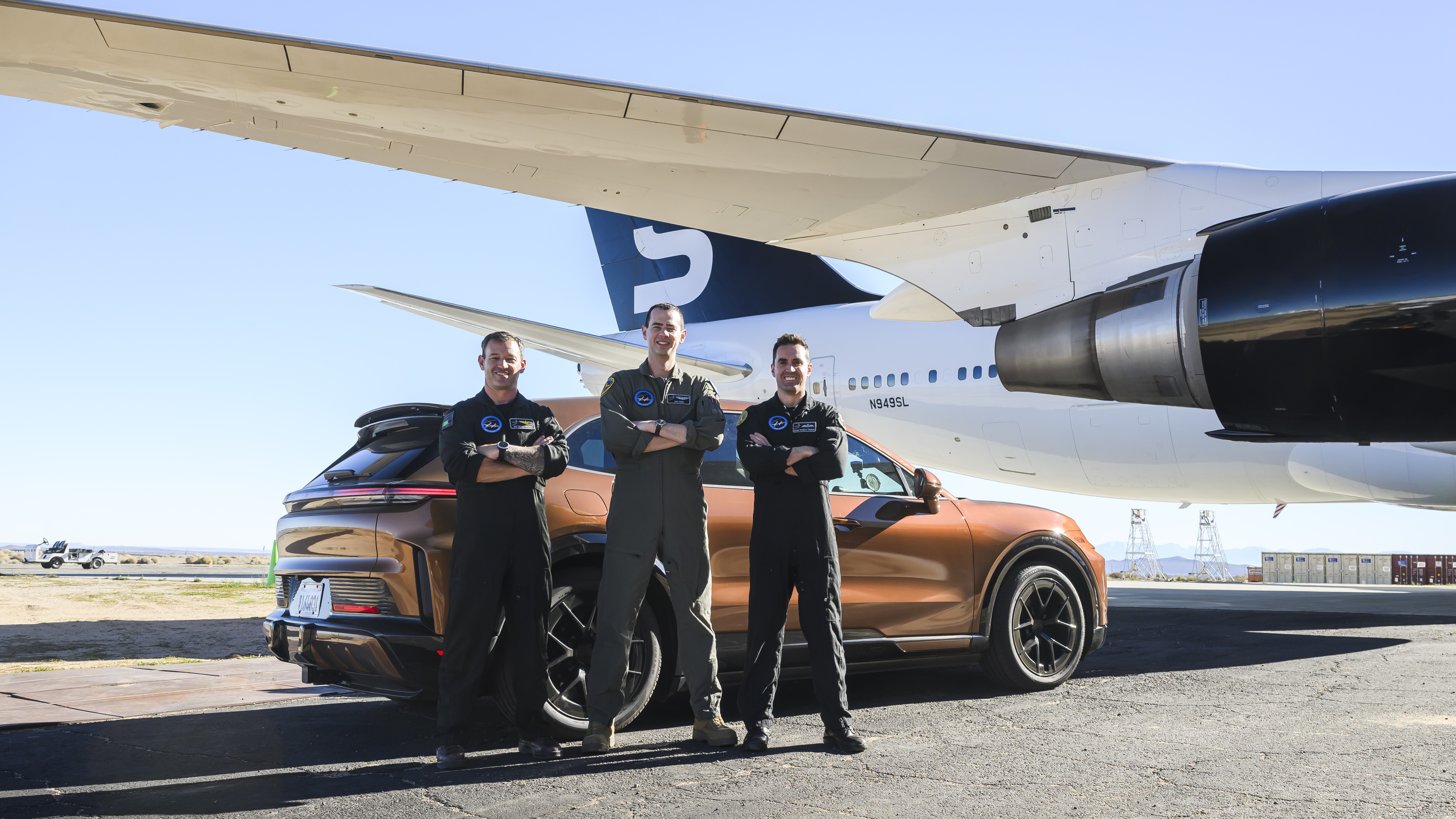
“I trusted Patrick and the Cayenne completely to do their job – meaning I just focused on doing mine,” said Stratolaunch chief test pilot Jonathan ‘Beast’ Bearce. “I couldn’t see him at all from my position but watching the footage back he positioned himself perfectly – that took a lot of guts, I was seriously impressed by Patrick’s composure and how the car handled pressure,” he continued. “Roc is designed to carry up to half a million pounds into the sky, and since we were carrying no payload, our acceleration was pretty impressive for such a large aircraft. Later, I drove the Cayenne with Patrick and that was the fastest I’ve ever accelerated in a car – I’m not sure we would have known where he’d gone if he had put his foot to the floor! But this was not just about outright speed – it was about absolute precision. And he got it spot on.”
With nerves settled and the theory proven by the first flight, the team began to explore the limits – including meeting Roc as it landed, repeating the decades long approach taken by the US Air Force and its Lockheed U-2 as it lands with the aid of a chase vehicle, albeit in this case with an aircraft possessing three times the wingspan. Coordinating with the pilots, Patrick Long accelerated beneath Roc, timing his run perfectly to arrive beneath the aircraft just behind the landing gear as it neared the ground.

In total, the Cayenne Turbo Electric would complete two take offs and two landings beneath Roc – emerging unscathed, with Patrick Long and passengers, Porsche Design brand ambassador Orlando Bloom, automotive journalist and enthusiast Mat Watson, and Stratolaunch crew chiefs Shauntel Williams and John McKinney, both exhilarated and relieved. Curiosity and belief in the data, the skill of two pilots and a driver, and complete faith in two groundbreaking machines had paid off.