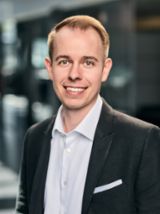
Florian, what brought you to Porsche, and where does your passion for sustainability and motorsport come from?
Dr. Florian Bach: I spent over six years working in motorsport for another German car manufacturer. From 2014 onwards, I had the opportunity to compete against Porsche in the World Endurance Championship, including at Le Mans. It was during this time that I first came into closer contact with the topic of sustainability. Ten years later, I joined Porsche Motorsport and took on responsibility for its sustainability strategy.
This has made a little dream of mine come true. With its numerous overall victories at Le Mans and its current involvement in four international racing series, Porsche has a unique motorsport heritage and a global presence across both professional and customer racing. The influence and visibility that comes with this legacy drives me every day, as it represents the opportunity to further develop motorsport at Porsche. That is why I remain inspired to this day by the combination of peak performance and innovation, coupled with the commitment to using resources as efficiently as possible.
At first sight, motorsport and sustainability may seem incompatible. How do you see these two topics fitting together?
Bach: For me, motorsport and sustainability are not a contradiction. Motorsport has always been a catalyst for innovation because new technologies can be developed and tested more quickly under extreme conditions. Our ambition is to drive these developments forward while reducing their environmental impact. In addition to our own convictions, external requirements also play an important role here, such as the sustainability accreditation from the International Automobile Federation (FIA), which is now a prerequisite for participation in various racing series. The shift in societal expectations is also becoming increasingly evident in motorsport. Our customer analysis shows a growing awareness of sustainability-related issues. At the same time, we see this as an opportunity to strengthen the credibility of Porsche Motorsport in the long term and to differentiate ourselves through innovative approaches.
What do you see as motorsport’s unique leverage when it comes to driving innovation in the context of sustainability?
Bach: Motorsport is constantly pushing the very limits of performance. This allows new technologies and materials to be tested and tried under real-world extreme conditions. For Porsche, as a sports car manufacturer, this offers the opportunity to gain valuable insights for future vehicle developments. To this end, we work closely with numerous departments both within and beyond Porsche. For example, we represent Porsche on the FIA Sport Environment & Sustainability Commission, where we help shape the FIA’s sustainability strategy across brands. I therefore consider the close link between motorsport and production cars to be particularly important, both in terms of development methodologies and technologies. Each side can learn from and benefit from one another.
Where exactly can this link between motorsport and production cars be seen in the vehicle?
Bach: Our Production vehicles, for example, benefit directly from technologies that are first developed and validated in works motorsport. In the Porsche 99X Electric, we were able to test the electric motor’s direct oil cooling system and a regenerative braking and charging capacity of up to 600 kW under extreme racing conditions. This enables us to transfer these technologies to our road-going sports cars, even where the most stringent requirements apply.
Motorsport-derived developments have also been incorporated into production models in other vehicle projects. These include engine optimizations through pre-chamber ignition and exhaust gas energy recovery, as well as improved cooling concepts for the chassis and high-voltage systems.
Alongside powertrain and performance technologies, materials are also playing an increasingly important role. What kind of innovations does Porsche Motorsport pursue in this area?
Bach: By using recycled carbon fibers in 21 body components and using eFuels in the current Cup car, we are continuously driving forward the development of more sustainable technologies. The recycled carbon fibers are sourced from production offcuts of the 911 GT3 RS and are processed, together with a bio-based resin system, into new components such as the rear wing, doors and tailgate. This has enabled us to reduce both manufacturing-related CO₂ emissions as well as overall resource consumption.
Which other material concepts are currently in focus?
Bach: One particularly promising example is natural fiber-reinforced composites. In the new 911 GT4 R, which will be introduced for the 2027 motorsport season, components such as the doors, rear wing, engine cover and parts of the cockpit are already being manufactured from this material. Thanks to their natural raw material base, lower weight and CO₂ footprint, natural fiber composites offer significant environmental potential compared with conventional materials and can provide valuable insights for future applications in both motorsport and series production.
The focus on more environmentally sustainable materials is not limited to the vehicles themselves. Together with tire manufacturer Michelin, we are already using racing tires that consist of more than 50 percent bio-based and recycled materials, such as pine resin and recycled scrap tires.
Are there any projects or initiatives apart from the vehicles themselves that demonstrate how sustainability is being implemented at Porsche Motorsport?
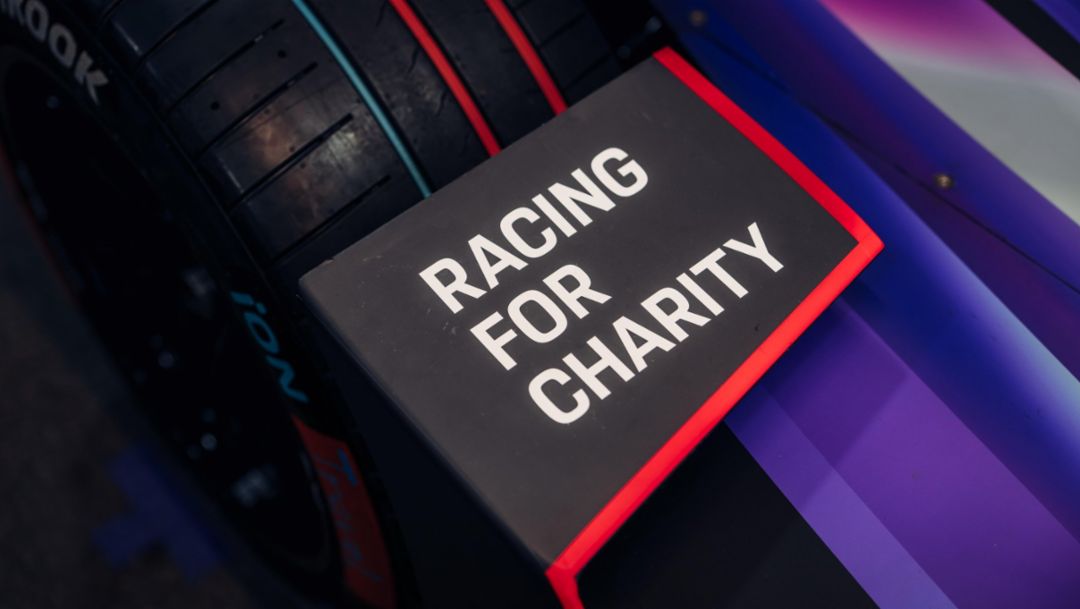
Bach: We take a holistic approach to sustainability, covering everything from infrastructure and products to events. We are also implementing concrete measures to reduce emissions at our development plant in Weissach. Our truck fleet operates from Weissach using the renewable fuel HVO100 and a fully electric tractor trailer has been in use since 2026. Furthermore, we have continued to optimize our logistics processes to conserve resources and reduce waste. We are also actively involved in social initiatives, for example through our „Racing for Charity“ initiative, through which we have already been able to convert numerous kilometers into tangible support for social projects.
The issue of data and reporting is also playing an increasingly important role in sustainability – including in motorsport?
Bach: A key element is the creation of reliable data foundations that enable us to assess and further develop measures in a targeted manner. For example, we conducted a life cycle assessment of the Porsche 911 GT3 Cup to identify major emission hotspots and evaluate the impact of individual measures on a factual basis. For me, transparency is also a crucial factor in successful sustainability work. Only when we know where the key influencing factors lie can we identify targeted improvements. That is therefore the focus of an important project we are currently undertaking: the implementation of a carbon accounting tool to further develop our CO₂ quantification.
One final question: What do you personally find most inspiring about your job, and what would you like to achieve in the future?
Bach: I am particularly passionate about the wide range of topics and the close collaboration with a large variety of people within the company. It is especially through different perspectives and open dialogue that the most exciting discussions and ideas emerge.
My aim is to embed sustainability even more firmly and for the long term within motorsport. Achieving this requires teamwork, openness to new approaches and a willingness to break new ground. At the same time, it offers the opportunity to drive innovation and further develop motorsport. Perhaps that is where a unique parallel to motorsport lies: in both cases, it’s about continuous improvement. In racing, the constant pursuit is for the next tenth of a second - driven by the same ambition to further enhance performance, efficiency and quality.
Info
In the interview series "Perspectives on Sustainability", Porsche employees talk about their specialist subject areas. The interview with Dr. Florian Bach is part 21 of the series.