Dubai | The inspirations behind the newly-unveiled Porsche Mission S concept will be on display at the Icons of Porsche festival in Dubai on 21-22 November 2026.
The famous Porsche Museum in Stuttgart will again support the largest automotive festival in the region, sending four classics from its collection to Dubai.
“Each year we have watched Icons of Porsche grow in stature and it’s an event we look forward to supporting with cars that always tell an amazing story,” said Achim Stejskal, Director of Porsche Heritage and Museum, Porsche AG.
A rundown on the Porsche Museum cars on display at Icons of Porsche in Dubai 2026:
Porsche 911 GT1-98R GT1 001
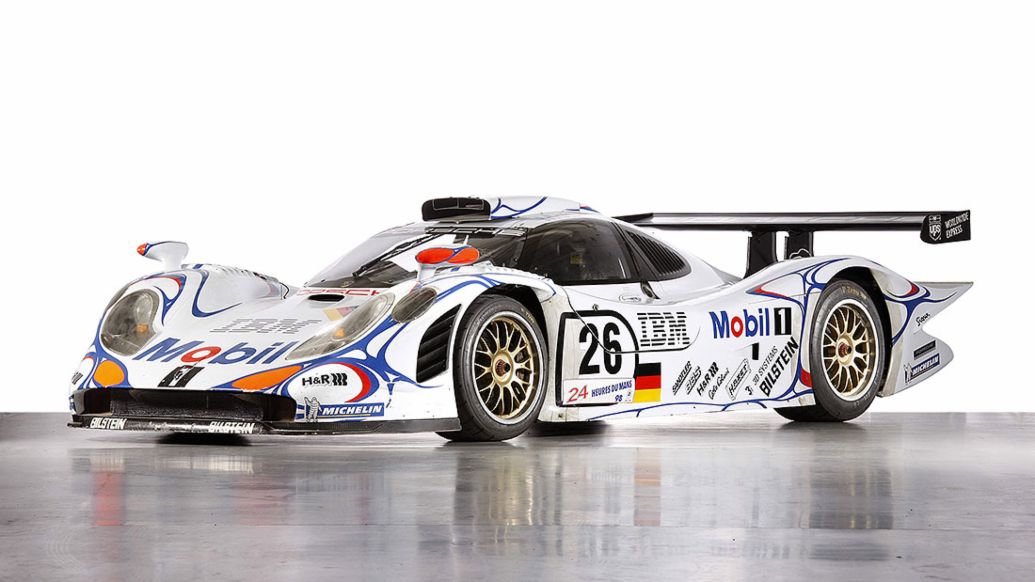
“The flat front takes its cue from the 911 GT1, while the car-in-car concept at the rear is also derived from the 911 GT1.”
The FIA announced a return to production-based sportscar racing for 1996, and Porsche accepted the challenge with the 911 GT1. It featured a water-cooled, mid-engine layout that gave the car a balanced axle-load distribution.
In 1998, the revised 911 GT1-98R appeared featuring Porsche’s first carbon fibre chassis. Just five examples were made and its 3.2-litre, six-cylinder engine was good for 550hp and a top speed of 310km/h.
Chassis #001 was used as part of the program that gave Porsche its historic win in the 24 Hours of Le Mans in 1998. While it was the sister 911 GT1-98R driven by Laurent Aiello, Allan McNish and Stéphane Ortelli that won at Le Mans, this exact chassis went on to score pole position at Petit Le Mans at Road Atlanta in the USA, driven by Allan McNish, Yannick Dalmas and Uwe Altzen.
Porsche 917 KH Coupé
“The cooling solution on the Mission S engine is reminiscent of the Porsche 917’s radiator fan.”
There are few more iconic endurance racing cars in the world than the Porsche 917. It’s arguably Porsche’s most famous racing car after making its debut at the 1969 Geneva Motor Show.
Powered by a 4.5-litre, air-cooled, flat 12-cylinder engine developing 520hp, it could reach speeds of 350km/h.
The 917KH debuted in 1970 with a re-engineered body comprising a new rear, nose, wings and sills. It also featured a tweaked engine that produced 620hp and it won seven of the eight races it entered that season.
KH stands for ‘Kurzheck’, meaning ‘short tail’ in reference to the revised bodywork that provided better handling on shorter tracks, as well as improved aerodynamics and high-speed stability.
Drivers Hans Herman and Richard Attwood drove it to victory in the 1970 Le Mans 24 Hour, with team-mate Gerard Larousse and Wili Kauhsen taking second place overall in a Porsche 917 Longtail. It backed up this win with another Le Mans victory the next year with drivers Helmut Marko and Gijs van Lennep and took a further 37 wins before the end of 1975.
Porsche 550 A Spyder
“The Mission S was unveiled in New York at the exact spot, overlooking the Manhattan skyline, where a famous photo of the 550 Spyder was taken, just after it was unloaded on to the dock upon its arrival in the United States.”
The 1954 Porsche 550 A Spyder holds a special place in the history of Porsche being the company’s first car built for motor racing. This effectively made it the first Porsche ‘super sports car’.
While the Porsche 356 was a road car that adapted successfully to racing, the 550 A Spyder was a primarily a race car that became a road car. This allowed the car to be legally driven to the track on public roads.
Its aluminium construction and mid-engine layout gave it a competitive edge of lightweight mixed with optimal balance to win over the competition with its tubular spaceframe chassis that was lighter and stiffer than the regular ladder frame chassis.
Despite its 1.5-litre, flat 4-cylinder engine developing 110hp, its weight of just 590kg allowed it to reach 220km/h, making it a class-winner in the gruelling Carrera Panamericana road race through Mexico and third outright.
Known as the ‘Giant Killer’, the 550 A Spyder won the 1956 Targa Florio outright on rough Sicilian roads.
Local ‘icons’ also on show
In addition to the Heritage cars from the Museum, the passionate UAE and wider Middle East community of Porsche owners is again supporting Icons of Porsche with a selection of locally sourced classic and sports cars spanning the past half century.
Porsche 959
“On the Mission S, the dynamic-looking roofline beneath the rear wing is reminiscent of the 959.”
It’s not often you can say one car revolutionised the world of supercars but Porsche’s 959 did exactly that, introducing all-wheel drive technology and active suspension in a twin sequential-turbocharged layout as a concept in 1983 before production in 1986.
With a top speed of 317km/h and a 0-100km/h time of just 3.7 seconds, the 959 re-wrote the rule book on supercars with performance superior to many V8 and V12 rivals via a 450hp, 2.85-litre, flat six-cylinder engine.
At the time it was considered the most technologically advanced road-going sportscar ever created and laid the foundations for Porsche’s future of delivering all-wheel drive, turbocharged sportscars.
Introduced at the 1985 Frankfurt Auto show, the Porsche 959 was limited to just 292 cars to satisfy the FIA’s rules of a minimum 200 cars for Group B rally homologation.
Porsche 911 G model
“The shut lines that merge into the light graphics pay homage to the 911 G model.”
Think of a Porsche and the first image that pops into your head is most likely the 911 G, a model run that lasted 17 years and looks just a fresh today as it did when it debuted in 1974.
For the G model series, the design of the Porsche 911 received a major overhaul as a Coupe, Targa and later as a full Cabriolet from 1983. The distinctive black ‘bellows’ appeared on the front and rear bumpers to meet US crash safety laws which became an identifiable feature of the 911 G for the next decade.
The G combined the original 911's character with more power, improved safety and greater refinement as well as introduced turbocharging with the unforgettable 911 Turbo in 1975. it initially offered a 3.0-litre turbo engine which later expanded to 3.3-litres.
Following the original 2.7-litre Porsche 911 G from 1974 to 1977, the 911 SC became the foundation of Porsche’s sportscar range from 1977 to 1983 with the Carrera 3.2 carrying the baton from 1984 to 1989.
Porsche 928
“The wheels on the Mission S are based on the iconic ‘dial design’ of the 928.”
In the mid-1970’s Porsche took an opportunity to expand beyond rear-engined sportscars and create a 2+2 Grand Tourer. Here came the front-engined V8-powered Porsche 928 in 1978.
Porsche’s staple attributes of lightweight technology and high-performance were retained as key elements and as a result, the 928’s doors, front wings and bonnet were made in aluminium.
To maximise its aerodynamics, the revolutionary front and rear bumpers were integrated into the body’s profile while still withstanding an 8km/h impact without damage.
The 928 also debuted a radical semi-trailing arm suspension as an early form of passive rear-wheel steering, eliminating oversteer that’s often caused by front-mounted V8 engine layouts.
Running from 1978 to 1992, the 928’s water-cooled V8 initially grew from 4.5-litres to 4.7-litres and made 310hp. It gained front and rear spoilers for the 928 S, and the V8 eventually expanded to 5.0-litres with 320hp in the all-wheel drive 928 S4, built from 1987 until 1991.
The 928 S4 rear featured wide, flush-fitting tail lights and a larger rear black spoiler. It was popular in both automatic and manual transmissions and complemented the 911 as the ultimate cross-country, long distance tourer.
Porsche 356
“The interior architecture of the Mission S is based on historic Porsche sports cars such as the 550 Spyder and the 356.”
The original; this is where it all began for Porsche, with the 356.
Introducing lightweight construction with a rear-mounted, air-cooled, flat engine, the 356 wrote the DNA for Porsche’s sportscar legacy that continues to this day.
It all began on June 8, 1948 when the first car bearing the Porsche name, a 356/1 Roadster, was approved for production.
Known as the "Gmünd Roadster" because it was completed in Gmund, Austria, it’s now widely known as 356 “No. 1,”
A unique feature is that all 356s were available from the beginning with open-top versions of Cabriolet, Speedster or Roadster alongside the hard top coupes.
76,000 examples were made until 1966, growing from the original 1.1-litre 356, to the 356 A, 356 B and the final 356 C derivatives which featured a 2-litre, 130hp engine in the final GS Carrera.
75 Years of Porsche Motorsport
As well as being cars that inspired the Mission S concept, some of these vehicles also contribute to the celebration of 75 Years of Porsche Motorsport.
An addition to this theme is a very special Porsche race car – one that actually won a Formula 1 Grand Prix in the hands of the late American racing legend Dan Gurney.
Porsche Typ 804 Formula 1 car
Porsche scored its first F1 Grand Prix victory in 1962 with the 1.5-litre, eight-cylinder, Typ 804 in the hands of Dan Gurney.
After debuting at Zandvoort that year, Gurney then won the French Grand Prix at Rouen and claimed a 1-2 victory in the Solitude race of Stuttgart with his team mate Jo Bonnier in a second Typ 804 before taking another podium trophy with third place in the German Grand Prix at the Nürburgring.
Designed by Ferdinand Alexander ‘Butzi’ Porsche, it weighed just 460kg and was powered by an air-cooled, flat 8-cylinder engine producing 180hp. This was good enough to give it a top speed of 270km/h and it was also the first Porsche to feature four-wheel disc brakes.
Four cars were built in total and all are believed to still exist.
Icons of Porsche
Icons of Porsche is the region’s largest automotive festival, bringing together classic cars, art and culture from across the Porsche community. Last year’s fifth edition welcomed more than 30,000 fans over the weekend, with over 1,000 sports cars on display.
Tickets to this November’s Icons of Porsche festival in Dubai are on-sale now via IconsOfPorsche.com, priced at 85 AED. Children under the age of 12 can register for free tickets when accompanied by a ticketed adult.
Follow Porsche Middle East and Africa on Instagram @porsche.middleeast for more event updates.
All Icons of Porsche press materials can be found on the Porsche Newsroom here.

