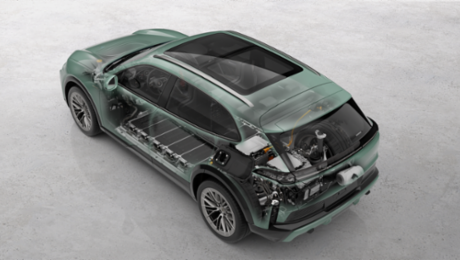
Porsche developed the battery modules for the new Cayenne entirely from the ground up. Instead of relying on external solutions, the sports car manufacturer remains in control of crucial factors. After all, the high-voltage battery is much more than simply an energy storage device – it shapes the performance, efficiency and everyday usability of the entire car.
The modular architecture of the Porsche battery is designed specifically with future-proofing in mind. Scalability and design flexibility make it possible to accommodate different vehicle derivatives and performance levels. Repairability was also taken into consideration from the very beginning. For example, individual battery modules are interchangeable and can be replaced, and the electronics of the cell stacks are easily accessible thanks to specially designed service flaps.
The decision to develop the battery in-house enabled a lean and efficient development process. Above all, it ensured that no compromises had to be made in terms of Porsche-specific product standards and characteristics. An ambitious list of specification criteria defined the requirements early on; the battery of the all-electric Cayenne was to have an energy capacity about 15 per cent greater than that of the current Taycan – therefore achieving maximum energy density of the cells. It was also decided that the battery must set new standards both in terms of power output (important for performance, such as acceleration from 0 to 200 km/h) and power input (important for recuperation and charging).
Porsche’s decision to use pouch cells underlines this goal. Pouch cells are much more complex to develop and produce than other cell formats but offer decisive advantages in terms of performance and packaging. Given the need for high power and low weight when it comes to overall performance, this opens up significant advantages that are of key importance for a sports car.
Thermal management plays a central role too – and it is a factor that is taken into consideration even at the individual cell level at Porsche. High thermal demands are taken into account right from the start, for example through extremely tight tolerances within the cell stack and the precise connection of the cooling system. As there was no suitable cooling solution available on the market, Porsche resolved to develop its own innovative double cooling system.
The overall battery system is complex and places the highest demands on development and production. Here, another strategic advantage comes into play; with Porsche Werkzeugbau GmbH, the sports car manufacturer can tap into decades of manufacturing and toolmaking expertise. The subsidiary has the know-how to implement sophisticated manufacturing techniques and deliver functional integration at the highest level. The production strategy and layout of the Smart Battery Shop (see separate chapter) were therefore defined by Porsche Werkzeugbau GmbH. The close proximity of the battery and the body are the result of the integrated development chain.
The in-house development and production of the battery modules is therefore a logical step towards firmly carrying Porsche's performance standards through to the age of electric mobility. It creates the foundation for Porsche to transfer its DNA into the electric future without compromise.
Innovative cell chemistry and intelligent thermal management
The new Cayenne features what is referred to as a function-integrated high-voltage battery. With this design, the battery becomes part of the body structure and performs other functions in addition to storing energy. This approach saves weight and allows for a more spacious interior. At the same time, the function-integrated battery increases the rigidity of the car’s body and lowers the centre of gravity even further, making the Cayenne Electric even more responsive and agile to drive.
The high-voltage battery, which has been developed from scratch, features a gross energy capacity of 113 kWh. Combined with its 800-volt architecture and the efficient drive system, this enables a long-distance range of more than 600 kilometres. Compared to the Taycan, the battery in the Cayenne has fewer, but significantly larger, cells; its lithium-ion battery consists of six modules and 192 large cells.
The type of cells used are known as pouch cells. A flexible aluminium-polymer foil encloses the electrode stack. The anode consists mainly of graphite, plus six per cent silicon. Graphite anodes offer high mechanical stability and excellent cycle stability. Silicon increases the specific energy density and enhances the fast-charging capability. Nickel-manganese- cobalt-aluminium (NMCA) is used for the cathodes. In order to achieve the highest possible energy density, a particularly large proportion of nickel is used in the NMCA material, with a nickel content of 86 per cent. The additional use of aluminium increases the energy content and further enhances electrical stability, which in turn has a positive effect on the service life of the cell. The bottom line is that the Cayenne battery achieves an energy density about seven per cent higher than that of the Taycan.
The intelligent thermal management makes a significant contribution to the high charging performance and long service life of the high-voltage battery. A key innovation is the cooling strategy of the high-voltage battery – in the Cayenne Electric, two cooling plates are being used for the first time. They are able to cool or heat the battery from above and below as required, enabling the optimal temperature window to be maintained more effectively.