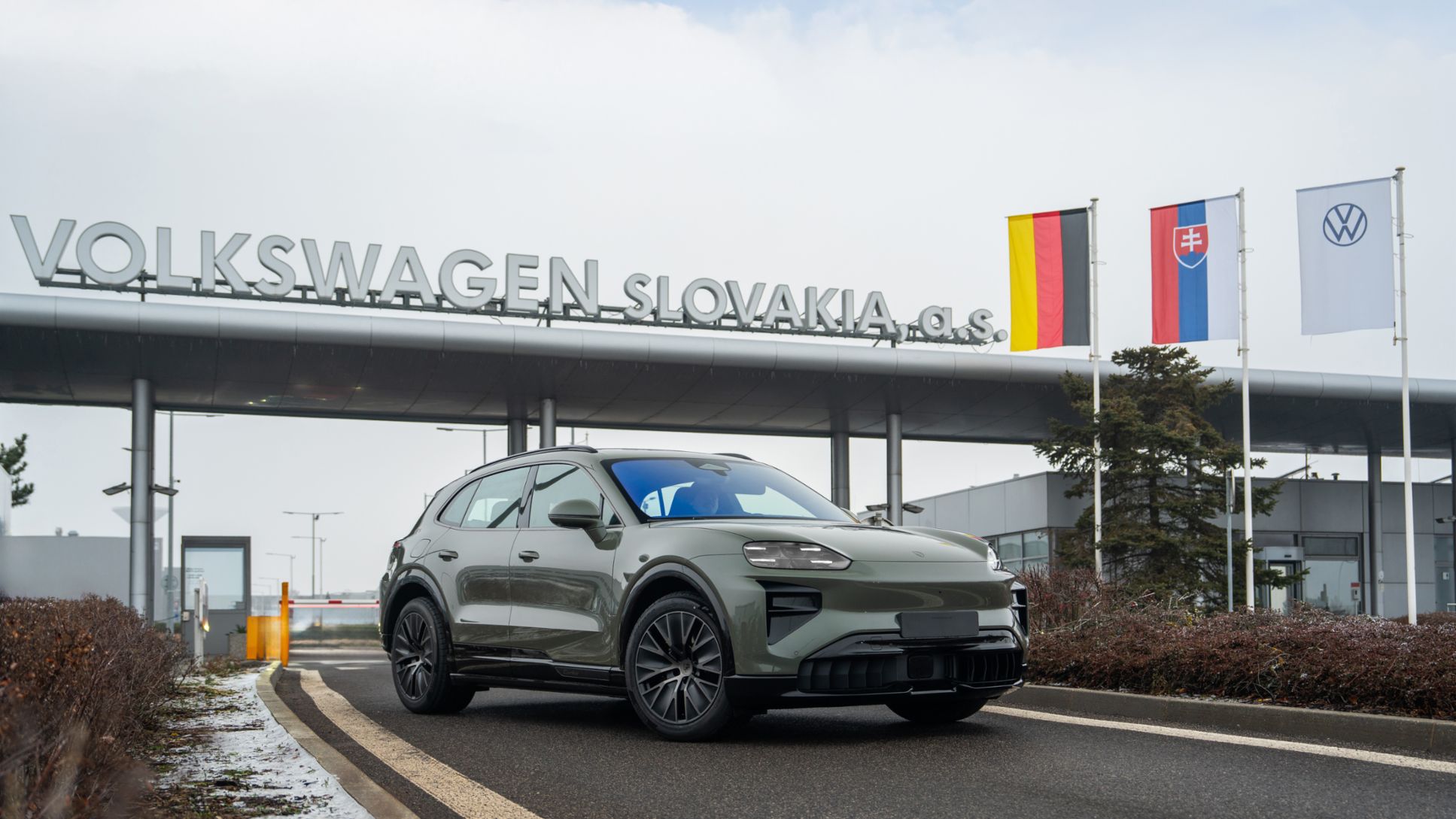
Since production began in 2002, the Cayenne has been closely linked to Bratislava. Initially, the bodies were manufactured and partially assembled there, before being transported to Leipzig. When the third generation of the SUV arrived in 2017, Porsche relocated production entirely to the Slovakian capital. From 2026, the Cayenne Electric will also be produced here – on the same line as the models equipped with combustion engines and hybrid drive systems. This flexible production setup enables Porsche to react quickly to changes in demand.
The Volkswagen Group's multi-brand site in the Devínska Nová Ves district has been extensively expanded for production of the electric SUV. At the heart of the renovation measures is a new ‘platform hall’ – the place where each new Cayenne Electric is born. This is where the skateboard-like chassis is constructed and then fitted with the side panels, roof, doors, bonnet and tailgate in the subsequent steps. These body panels come from the press shop. With an almost fully automated pressing line, it is one of the most modern press shops in Europe. The maximum force applied by the main press is 91,000 kilonewtons (kN).
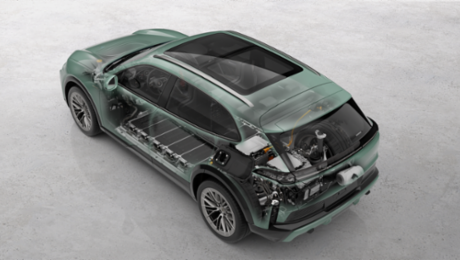
The assembled body then undergoes quality inspection. Here, staff carefully check the joints and surface quality, among various other factors. If all the quality requirements are met, the car is then handed over to the paint shop. The high-voltage battery and drive units are installed in the assembly hall. The top-of-the-range model, the Cayenne Turbo, is fitted with a rear-axle electric drive unit developed in Weissach. It is produced in Werk 4 in Zuffenhausen and delivered to Bratislava where it is installed in the car. Regardless of where they are developed and produced, every type of drive system used in the Cayenne is true to the typical Porsche principles and characteristics.
Final assembly also takes place in the assembly hall. The interior is fitted to the body, with customised features added according to the customer's individual specifications (see separate chapter). Exterior components, such as windows, headlights and other add-on parts are installed.
Porsche is the first car manufacturer to bring inductive charging to market maturity. The all-electric Cayenne will be the first model series that can be ordered with the relevant onboard equipment for Porsche Wireless Charging. A dedicated test area at the Bratislava plant ensures the smooth operation of the wireless charging feature.
Alongside test drives, final checks are another important quality control step. Cars of all model variants are subjected to thorough final inspection.
Faster installation of up-to-date software versions
In order to distinguish between a Cayenne and a Cayenne Turbo, for example, each car carries a transponder (RFID tag) with an identification code containing all the vehicle-relevant information. Each Cayenne is also equipped with and connected to a multifunction tester. This device performs a variety of functions, including transferring the latest software versions, recording all essential parameters during production, and monitoring battery temperature, for example. All the data from the production process is collated in the ‘Mission Control’ area. This means that any deviations can be detected immediately and corrected straight away.
Thanks to the Cayenne's new electronic architecture, the vehicle software can be installed much faster and more efficiently than was the case with the previous generation. Flashing – the name for the process of updating the firmware or operating system – enables each car to be delivered with the latest software version.
The resident model: a bridge between Weissach and Bratislava
Manufacturing processes are virtually simulated and optimised even before they are physically implemented in the factory. This approach increases operational efficiency. At the same time, Porsche relies on proven analogue expertise and use of what is known as the ‘resident model’; to ensure seamless collaboration, a small group of Porsche AG employees is permanently present at the Bratislava plant. They address any difficulties that arise directly – bringing the issues to the wider Porsche organisation and thereby ensuring a fast, targeted exchange within the highly dynamic environment of a new vehicle launch. The ‘residents’ form a bridge between vehicle development and production – and vice versa – and at the same time naturally reduce the distance between Weissach and Bratislava.
This small team is made up of employees from divisions such as logistics, development, body construction, powertrain and software. They make a significant contribution to the optimisation of processes and preparation for the ramp-up of production.
Reduced resource consumption, higher efficiency, reduced climate impact
Porsche actively recognises its environmental responsibility along the entire supply chain for its vehicles. For the Cayenne Electric, targeted sustainability measures have been initiated along the supply chain in order to reduce its climate impact.
Two key factors that influence the climate impact of the Cayenne Electric are the increased use of recycled and CO₂-reduced aluminium and the reduction of CO₂ emissions from the production of high-voltage battery cells. With measured implemented throughout the supply chain and production, Porsche has been able to reduce the climate impact of its high-voltage battery cells by about half. This was achieved in part through the use of CO₂-reduced nickel and lithium, as well as electricity from renewable sources, in battery cell production.
With each new all-electric vehicle, charging throughout its life creates an additional demand for electricity. Porsche is therefore supporting the large-scale expansion of new wind and solar plants that generate energy that is fed into the power grids.
The Cayenne Electric is produced using electricity only from renewable sources, most of which comes from Slovakian hydroelectric power plants. A powerful heat pump uses the waste heat energy from the body shop to warm the premises.
Efficient use of energy further reduces CO₂ emissions, for example by optimising temperatures in the painting and filler booths and by programming the robots in the body shop to enter sleep mode automatically during break times. The consumption of mains drinking water in production has also been greatly reduced, thanks to the water required for the various manufacturing processes now being sourced from the company's own well. These and other measures are having a significant impact. Between 2010 and 2024, the Volkswagen Group was able to reduce the environmental impact per vehicle produced at its Bratislava site by an average of 66.8 per cent across the five key indicators (energy and water consumption, waste material disposal, and CO₂ and VOC emissions).
Facts, figures, data
- Founded in 1971 as Bratislavské automobilové závody n.p. (Bratislava Automobile Works), the Bratislava plant has been part of Volkswagen AG since 1991.
- Twelve models from four Group brands are currently produced at the multi-brand site.
- In 2024, a total of 341,111 vehicles were produced, almost half of which were equipped with electrified drive systems.
- With about 12,500 employees2, the plant is the largest private employer in Slovakia.
- At about two million square metres, the factory site is as large as 280 football fields.
- The Bratislava plant has 55,895 square metres of grass- and meadowland, which contributes to increasing biodiversity in the local environment. In addition, 1,632 deciduous and coniferous trees have been planted.
- The factory site is also home to 14 insect houses and 16 bird feeders, providing shelter for local fauna.
Spotlight
Extensive customisation from the factory
Never before has a Cayenne been as comprehensively and individually customisable as the new all-electric model. Customers can choose from 13 standard exterior colours, nine wheel designs ranging from 20 to 22 inches in diameter, 12 interior combinations, up to five interior packages and up to five accent packages. Through the range of features available from Porsche Exclusive Manufaktur, the extended choice of exterior colours available via the Paint to Sample programme, as well as the Sonderwunsch department, customers can also further customise their Cayenne – ranging from the installation of individual optional features to the creation of a unique, one-off car. As a result, the Cayenne Electric offers the greatest breadth and depth of customisation options ever available for a Porsche SUV.
Many bespoke customer colours and material choices for the interior and exterior are integrated directly into the production process at the Bratislava plant. More extensive customisation requires the vehicle to be transferred from the assembly line to a special assembly area. There, the highly experienced team fulfils the more elaborate customer requests. Once all the personalised components have been installed, the car is returned to the regular assembly line. In this way, Porsche can combine the strengths of automated production with the advantages of bespoke manufacturing of hand-built cars.
----------
¹Data at the end of 2024, permanent and temporary employees