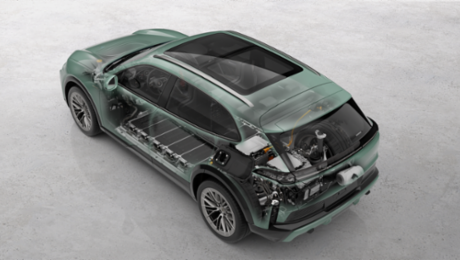
For the new generation of the Cayenne, Porsche is using high-voltage batteries developed and manufactured entirely in-house. In doing so, the sports car manufacturer is continuing to expand its own battery expertise in a focused manner and deepening its technological expertise in the field of electromobility while also laying the foundation for maximum performance, efficiency and quality – made in Europe.
Together with Porsche Werkzeugbau GmbH, in the Slovakian town of Horná Streda, Porsche has established the Porsche Smart Battery Shop – a state-of-the-art production facility for the next generation of battery modules. Its location was chosen deliberately because Porsche Werkzeugbau’s Technology Center was already based here. The facility has been expanded into an innovative technical centre that, as a dependable partner, supports Porsche in product and process development. About an hour's drive from Bratislava, this is where battery modules for the new Cayenne Electric will be produced in the future.
The close integration with Porsche Werkzeugbau was a key factor in the success of the project as expertise from prototype production could be seamlessly transferred to series production. Construction of the production hall, spanning an area of 40,200 square meters, began in January 2023. Installation of the production equipment began in September of the same year. Thanks to the intensive collaboration between those responsible for technical development in Weissach and production planning in Zuffenhausen, the project was completed in record time. In May 2024, the facility produced its first finished module.
In a complex, precisely orchestrated manufacturing process, 32 individual battery cells are combined to create a completed module. Six of these modules together form the high-voltage battery used in the Cayenne Electric.
The module production process essentially comprises the following stages:
- ESD and cleanliness: throughout the entire production process, the highest standards of ESD (Electro Static Discharge) protection and cleanliness are applied. These strict standards ensure excellent process capability at each stage of production, as well as the maximum possible level of quality in the finished high-voltage battery modules.
- Cell preparation: the pouch cells are first tested and prepared for the subsequent production steps.
- Stack formation: the cells are stacked on top of each other, with care and attention placed on their precise positioning, finely specified spacing and uniform alignment of the electrode connectors.
- Insertion of the cell carriers and preparation of the cell tabs: the cell stacks are inserted into the respective cell carriers. The cell tabs are then positioned and prepared for the welding process.
- Laser welding of the cell tabs: the cell tabs are joined using an automated laser welding process. This process ensures both electrical contact and mechanical bonding. Continuous quality checks of the joints and stacks are carried out.
- Applying foam: a foam material is added to stabilise and protect the cell stacks.
- Module integration: four tested cell stacks are inserted into a module housing and fixed in place.
- Gap filling: a thermally conductive filling material is inserted between the cells and cells stacks, further improving heat dissipation.
- Bonding of the cooling plates: the module housing is then bonded to the cooling plates to ensure permanent and thermally efficient connection of the cell stacks.
- Top plate assembly and welding: once the cell stacks have been inserted, the top plate is put in place and welded, ensuring a fully enclosed module assembly.
- End-of-line tests: finally, leak tests and various electrical checks are carried out, as well as dimensional checks, visual inspections, function tests and insulation measurements. This ensures that all cells are correctly welded, bonded and electrically connected.
- Shipping: once testing is complete, the modules are prepared for shipping. An external contractor then assembles the complete high-voltage battery from six individual modules.
Comprehensive quality control
The state-of-the-art module production facility carries out real-time process data acquisition, which guarantees full transparency and control at every stage of production. Before a battery module leaves the factory, all quality criteria are checked and all production data is securely archived in the cloud. This means that each module that is signed off has been subject to continuous quality control as it made its way through the manufacturing process. This allows the plant to access and provide relevant data immediately and ensure complete traceability even after many years.
In addition to product quality, Porsche also checks the performance of the battery – in particular relating to its longevity and charging capability. To this end, newly produced batteries are validated under laboratory conditions in the company's own analysis centre – as are related components that currently still come from test vehicles. To ensure that the high-voltage battery meets Porsche's exacting quality standards, extreme conditions are simulated – such as heat exposure from 60 to 100 degrees Celsius – and an immersion test is carried out.
In the next manufacturing step, a supplier equips the battery modules with the high-voltage cabling and the corresponding connectors. They are then transported ‘just in sequence’ (JIS) to the assembly line at the Bratislava plant.
Environment in Focus
The Smart Battery Shop is committed to environmentally friendly solutions and aims for a high level of self-sufficiency. By using photovoltaic elements to harness renewable energy and heat pumps for efficient energy supply, it contributes to reducing CO₂ emissions and promoting local climate protection. In addition, as a contribution to climate resilience, the factory’s roof surfaces are greened, and the site has its own well for water supply.
Facts, figures, data
About 40,000 square metres of factory grounds, ‘greenfield’ project, nine-month construction period (module 0 was produced in May 2024).
Subsidiary of the German Porsche Werkzeugbau GmbH and Porsche AG.
Streamlining effects through Porsche Werkzeugbau GmbH taking over areas such as administration, IT, human resources and purchasing.
About the Porsche Werkzeugbau Group
Porsche Werkzeugbau Group GmbH is a 100 per cent subsidiary of Dr. Ing. h.c. F. Porsche AG. In Schwarzenberg and in Dubnica (Slovakia), the company manufactures forming and cutting tools for Porsche as well as for other automobile manufacturers. In August 2015, Porsche acquired, and took over both sites from, the toolmaking division of robotics specialist Kuka and has since built up further expertise in automotive plant engineering and the development of production facilities.
Porsche Smart Battery Shop s.r.o., a subsidiary company that manufactures battery modules for the new Cayenne Electric in Horná Streda (Slovakia), was founded in 2022. After Porsche AG acquired V4Drive GmbH from the VARTA AG Group on 4 March 2025, renaming it as V4Smart GmbH, the Porsche Werkzeugbau Group once again expanded its fields of operation. The expansion of the battery production line at the Nördlingen site had already been led by the Porsche Werkzeugbau Group. The cells of the V4Smart are used as booster cells in the 911 GTS and 911 Turbo S.
The Porsche AG subsidiary is also active in two other fields: on behalf of Porsche Classic, the company manufactures body panels for classic and modern classic cars using the original tooling. Such components have already been issued for the 928, the 996-generation 911 and the original Boxster (986 generation). When buying a current-generation Porsche 911, customers can order the centre console with personalised leather embossing, for example with their own logo or lettering. The Porsche Werkzeugbau Group manufactures the embossing dies required for this and delivers them directly to the assembly line. In addition, the Porsche Werkzeugbau Group acts as a consultant for various customers in automotive production.